Expected value calculator
Multiply each outcome by its normalized weight and add the products.
Calculator
How to use this calculator
Calculate a probability-weighted average from matching outcomes and nonnegative weights.
- Enter Outcome values, Matching probability weights. Match the units shown beside each field and review the result together with the assumptions below.
- Read the worked example below to check the expected input format and result.
- Compare another scenario by changing one input at a time. Use Reset to return to the starting values.
Calculate a weighted mean of listed outcomes
Expected value is the probability-weighted average outcome. The entered nonnegative weights are normalized to total one, so they may be decimals or percentages whose total is not exactly 1 or 100.
Inputs and units
- Outcome values: Finite numeric outcomes, separated by commas or spaces.
- Matching probability weights: Nonnegative decimal or percentage weights in the same order; the calculator normalizes their total.
Formula and method
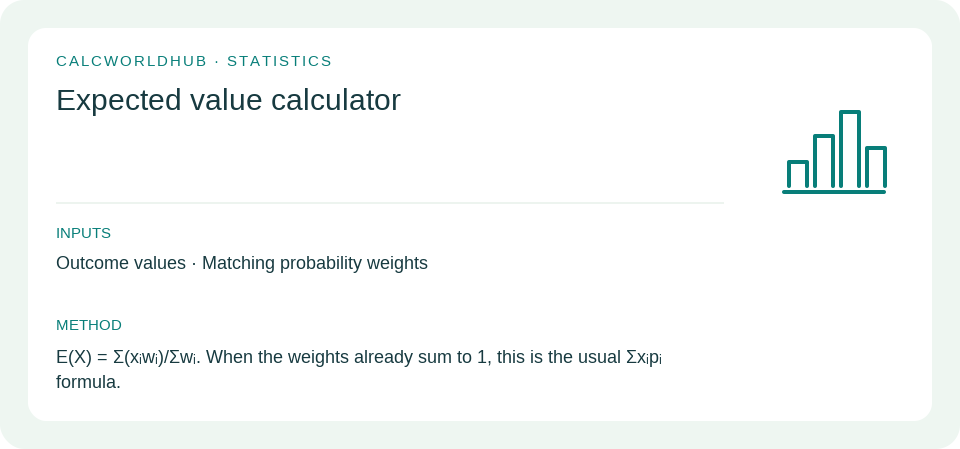
E(X) = Σ(xᵢwᵢ)/Σwᵢ. When the weights already sum to 1, this is the usual Σxᵢpᵢ formula.
Worked example
For outcomes −10, 0, 20 with weights 0.1, 0.7, 0.2, E(X) = (−10×0.1 + 0×0.7 + 20×0.2)/1 = 3.
Interpreting the result
The result is a long-run average for repeated comparable trials, not an outcome guaranteed on one trial.
Assumptions and limits
Possible outcomes should be complete and the weights should represent the intended relative probabilities. It does not describe variability or risk by itself.
Method references
Frequently asked questions
Must the weights sum exactly to one?
No. They are normalized by their positive total; entering probabilities that already sum to one leaves them unchanged.
Can expected value be outside the listed outcomes?
For nonnegative weights, it lies between the smallest and largest listed outcomes.
How do I use the Expected value calculator?
Enter Outcome values, Matching probability weights. Match the units shown beside each field and review the result together with the assumptions below.
What is a worked example of Expected value?
For outcomes −10, 0, 20 with weights 0.1, 0.7, 0.2, E(X) = (−10×0.1 + 0×0.7 + 20×0.2)/1 = 3.
What does the Expected value calculator calculate?
Calculate a probability-weighted average from matching outcomes and nonnegative weights.
Good calculators show their work.
CalcWorldHub is built around clear inputs and visible assumptions. Results are estimates for planning; check official sources or your provider’s terms when exact figures matter.