How to use this calculator
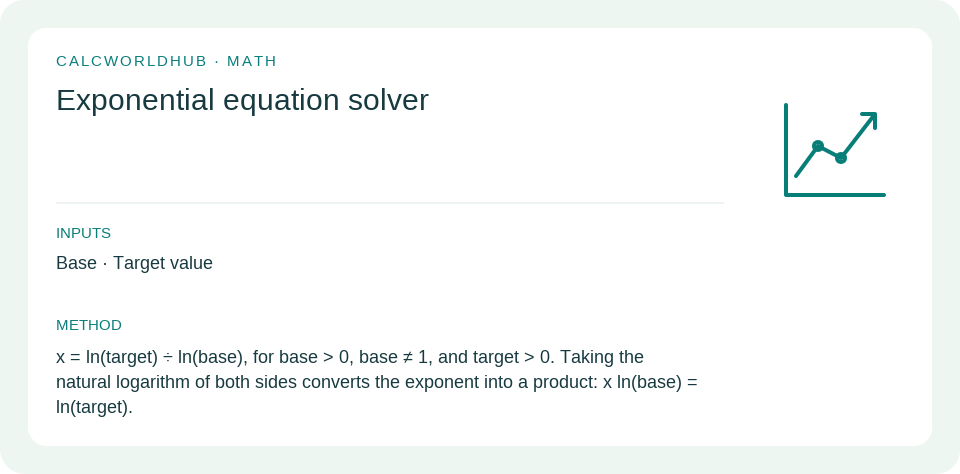
Solve a simple exponential equation with a variable exponent, baseˣ = target.
- Enter Base, Target value. Match the units shown beside each field and review the result together with the assumptions below.
- Read the worked example below to check the expected input format and result.
- Compare another scenario by changing one input at a time. Use Reset to return to the starting values.
How this calculation works
For y = a^x with positive a other than one, the unique real solution is x = ln(y)/ln(a), and the target y must be positive.
Inputs and meanings
base— Base- Enter a positive base other than 1.
target— Target value- Enter a positive right-hand side.
Formula and method
x = ln(target) ÷ ln(base), for base > 0, base ≠ 1, and target > 0.
Taking the natural logarithm of both sides converts the exponent into a product: x ln(base) = ln(target).
Worked example
For 3ˣ = 81, x = ln(81)/ln(3) = 4, and 3⁴ checks to 81.
Assumptions and limits
This real-valued solver requires a positive base other than one and a positive target. It does not solve equations with sums of exponentials or variable bases.
Frequently asked questions
Can the base be between zero and one?
Yes. A base strictly between 0 and 1 is allowed and produces a decreasing exponential; the exponent may be negative or positive.
Why can the base not be 1?
1 raised to any real exponent is always 1, so there is no unique exponent to solve for.
Why must the target be positive?
A positive base raised to a real exponent is positive, and the logarithm method requires a positive target.
How do I use the Exponential equation solver?
Enter Base, Target value. Match the units shown beside each field and review the result together with the assumptions below.
What is a worked example of Exponential equation solver?
For 3ˣ = 81, x = ln(81)/ln(3) = 4, and 3⁴ checks to 81.
Read our calculation methodology.