How to use this calculator
Plan a fantasy football auction bid while reserving enough budget to fill every remaining roster slot at the minimum bid.
- Enter Team auction budget ($), Amount already spent ($), Total roster spots, Roster spots filled, then complete the remaining labeled fields. Match the units shown beside each field and review the result together with the assumptions below.
- Read the worked example below to check the expected input format and result.
- Compare another scenario by changing one input at a time. Use Reset to return to the starting values.
How this calculation works
Auction budget decisions depend on both cash left and empty roster spots. Enter your team’s total budget, current spend, roster size, filled slots, and minimum legal bid to see an average remaining budget, the minimum reserve, and the largest bid that still leaves minimum bids for every other open slot.
Inputs and units
totalBudget— Team auction budget ($)- Total auction money available to the team for this roster.
amountSpent— Amount already spent ($)- Cumulative bids already charged to the team.
rosterSpotsTotal— Total roster spots- Number of roster positions to fill in this auction budget model.
rosterSpotsFilled— Roster spots filled- Number of these roster spots already filled.
minimumBid— Minimum bid per open slot ($)- Smallest permitted bid used to reserve money for every unfilled roster spot.
Formula
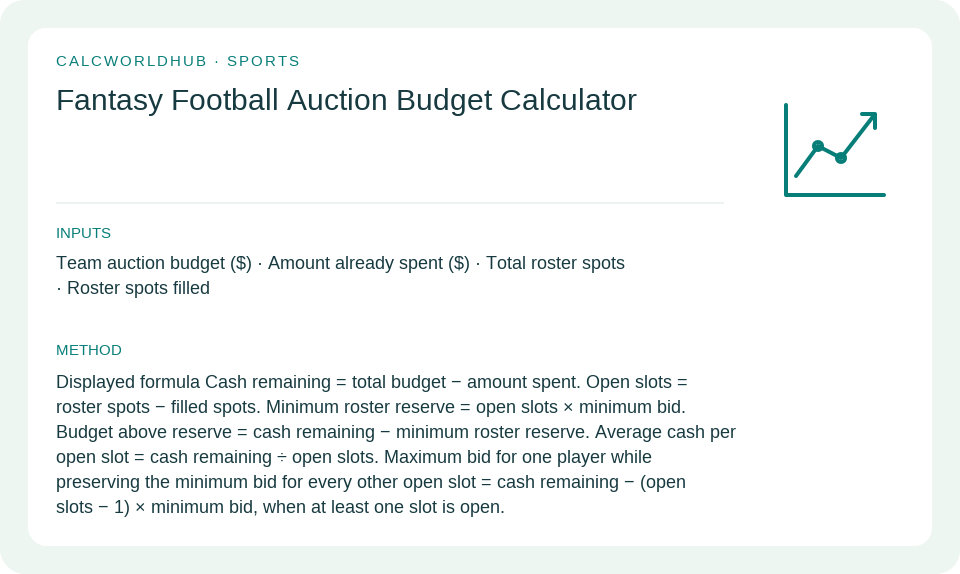
Cash remaining = total budget − amount spent. Open slots = roster spots − filled spots. Minimum roster reserve = open slots × minimum bid. Budget above reserve = cash remaining − minimum roster reserve. Average cash per open slot = cash remaining ÷ open slots. Maximum bid for one player while preserving the minimum bid for every other open slot = cash remaining − (open slots − 1) × minimum bid, when at least one slot is open.
Method
The reserve protects one minimum bid for every open slot. The maximum single bid assumes all other open slots can be filled at exactly the entered minimum; it is a mathematical ceiling, not a player valuation or recommendation.
Worked example
With a $200 budget, $70 spent, 15 total roster spots, 5 filled, and a $1 minimum bid, cash remaining is $130 across 10 open spots. The minimum reserve is $10, leaving $120 above minimums. The average cash per open spot is $13, and the largest one-player bid that preserves $1 for each of the other nine spots is $121.
Assumptions and limits
This planner does not use player projections, position limits, keeper costs, auction inflation, nomination strategy, roster eligibility, or platform-specific rules. Enter a minimum bid and roster count that match your league. It does not decide what any player is worth. When no roster spots remain, the average-per-open-spot and maximum-bid displays use zero as a not-applicable convention; there is no open-slot average or additional legal player bid in this model.
Frequently asked questions
Why is the maximum bid higher than the average per open spot?
The maximum calculation allows one player to use almost all remaining discretionary cash while reserving only the minimum bid for every other empty roster spot.
Does the maximum bid mean I should spend that much?
No. It is only a budget boundary under the entered minimum-bid rule; player value and future needs are not modeled.
What happens if the remaining budget cannot cover all open spots?
The calculator reports a validation error because the entered roster cannot be completed at the minimum bid under that budget.
Does this account for positional roster limits?
No. It models the total number of open spots and one minimum bid, without position, keeper, or platform-specific rules.
How do I use the Fantasy Football Auction Budget Calculator?
Enter Team auction budget ($), Amount already spent ($), Total roster spots, Roster spots filled, then complete the remaining labeled fields. Match the units shown beside each field and review the result together with the assumptions below.
Read our calculation methodology.