How to use this calculator
Apply the daily FAO-56 reference-grass equation to supplied weather terms.
- Enter Mean air temperature (°C), Net radiation (MJ/m²/day), Soil heat flux (MJ/m²/day), Wind speed at 2 m (m/s), then complete the remaining labeled fields. Match the units shown beside each field and review the result together with the assumptions below.
- Read the worked example below to check the expected input format and result.
- Compare another scenario by changing one input at a time. Use Reset to return to the starting values.
FAO Penman Monteith daily reference ETo explained
Apply FAO-56 daily Penman–Monteith to net radiation, soil heat flux, temperature, wind, and vapor pressure to estimate standardized reference evapotranspiration in mm/day.
A numerical walkthrough
Mean air temperature (°C) = 20; Net radiation (MJ/m²/day) = 10; Soil heat flux (MJ/m²/day) = 0; Wind speed at 2 m (m/s) = 2; Saturation vapor pressure (kPa) = 2.34; Actual vapor pressure (kPa) = 1.4; Saturation-pressure slope (kPa/°C) = 0.145; Psychrometric constant (kPa/°C) = 0.066.
- Daily reference evapotranspiration: 3.801521 mm/day
This is 3.801521 mm/day for the standardized reference surface, not crop-specific water use; a crop coefficient or local method is needed to estimate field evapotranspiration.
The model behind the numbers
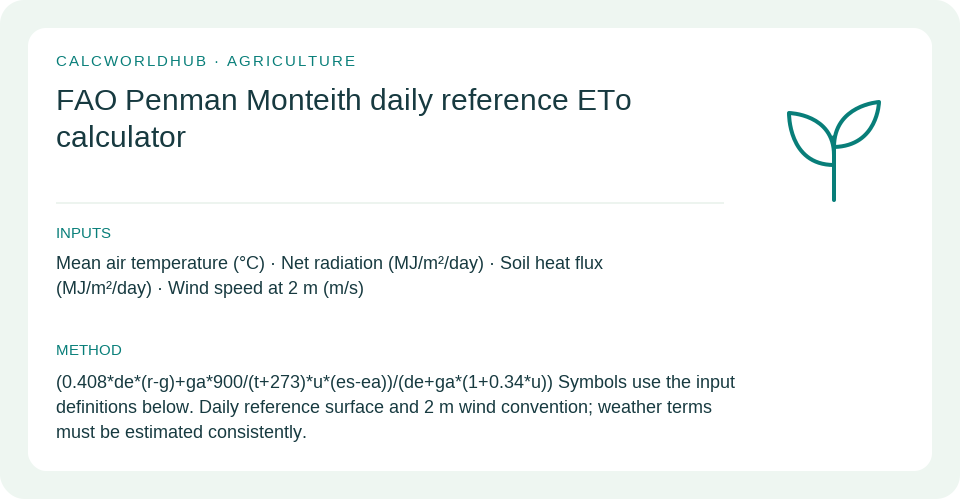
(0.408*de*(r-g)+ga*900/(t+273)*u*(es-ea))/(de+ga*(1+0.34*u))
Symbols use the input definitions below. Daily reference surface and 2 m wind convention; weather terms must be estimated consistently.
What to enter
t— Mean air temperature (°C)- Mean air temperature (°C).
r— Net radiation (MJ/m²/day)- Net radiation (MJ/m²/day).
g— Soil heat flux (MJ/m²/day)- Soil heat flux (MJ/m²/day).
u— Wind speed at 2 m (m/s)- Wind speed at 2 m (m/s).
es— Saturation vapor pressure (kPa)- Saturation vapor pressure (kPa).
ea— Actual vapor pressure (kPa)- Actual vapor pressure (kPa).
de— Saturation-pressure slope (kPa/°C)- Saturation-pressure slope (kPa/°C).
ga— Psychrometric constant (kPa/°C)- Psychrometric constant (kPa/°C).
Interpreting the result
Daily reference surface and 2 m wind convention; weather terms must be estimated consistently. Signed results are retained rather than silently clipped.
Frequently asked questions
Is this actual irrigation demand?
No, crop, rainfall, soil-water, and system-efficiency adjustments are separate.
Can I enter 10 m wind directly?
Convert it to the 2 m reference first.
Why supply vapor-pressure slope?
It allows an explicit, auditable set of meteorological terms.
How do I use the FAO Penman Monteith daily reference ETo calculator?
Enter Mean air temperature (°C), Net radiation (MJ/m²/day), Soil heat flux (MJ/m²/day), Wind speed at 2 m (m/s), then complete the remaining labeled fields. Match the units shown beside each field and review the result together with the assumptions below.
What is a worked example of FAO Penman Monteith daily reference ETo?
Mean air temperature (°C) = 20; Net radiation (MJ/m²/day) = 10; Soil heat flux (MJ/m²/day) = 0; Wind speed at 2 m (m/s) = 2; Saturation vapor pressure (kPa) = 2.34; Actual vapor pressure (kPa) = 1.4; Saturation-pressure slope (kPa/°C) = 0.145; Psychrometric constant (kPa/°C) = 0.066. Daily reference evapotranspiration: 3.801521 mm/day This is 3.801521 mm/day for the standardized reference surface, not crop-specific water use; a crop coefficient or local method is needed to estimate field evapotranspiration.
Method reference: FAO Penman–Monteith method.
Read our calculation methodology.