How to use this calculator
Convert product used over a measured spreader test course into an application rate per hectare and compare it with a target.
- Enter Product loaded before test (kg), Product remaining after test (kg), Effective spread width (m), Test course distance (m), then complete the remaining labeled fields. Match the units shown beside each field and review the result together with the assumptions below.
- Read the worked example below to check the expected input format and result.
- Compare another scenario by changing one input at a time. Use Reset to return to the starting values.
How this calculation works
A calibration run turns a known treated area and measured product use into an observed field rate. Enter the amount loaded and left after the run, then define the effective swath and travel distance so the tool can report the rate and the target mass for that same test area.
Inputs and units
startingKg— Product loaded before test (kg)- Mass of product placed in the spreader before the measured course.
remainingKg— Product remaining after test (kg)- Mass left in the hopper after the test; must not exceed starting mass.
swathM— Effective spread width (m)- Measured effective swath used for this calibration method.
distanceM— Test course distance (m)- Distance travelled while applying product during the test.
targetKgHa— Target application rate (kg/ha)- Target rate from the product plan or label, in kilograms per hectare.
Formula
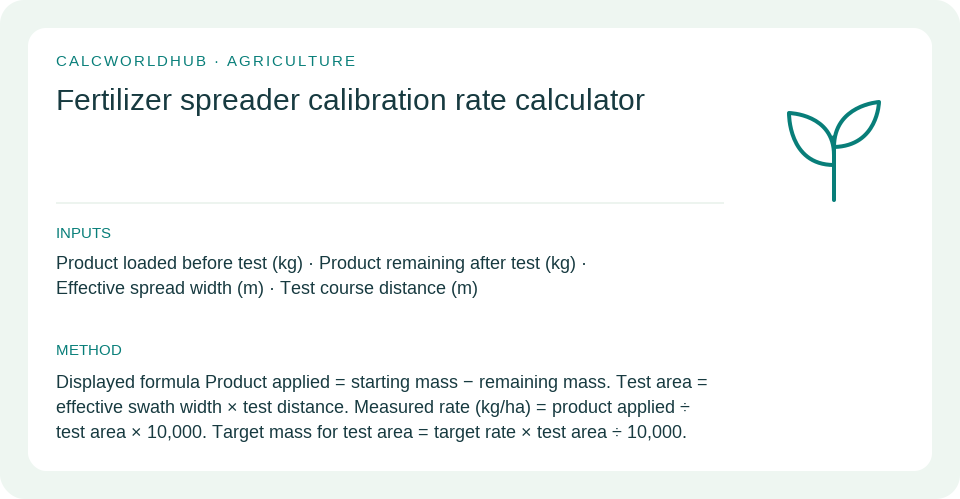
Product applied = starting mass − remaining mass. Test area = effective swath width × test distance. Measured rate (kg/ha) = product applied ÷ test area × 10,000. Target mass for test area = target rate × test area ÷ 10,000.
Method
Measure the effective spread width and course length, and weigh product before and after the run. Enter all mass in kilograms and distances in metres. Compare the measured rate with the product-label target and repeat the physical calibration after changing the spreader setting.
Worked example
If a 2.5 kg load leaves 0.7 kg after a 50 m course with a 6 m effective swath, 1.8 kg was applied over 300 m². The measured rate is 1.8 ÷ 300 × 10,000 = 60 kg/ha. A 40 kg/ha target would require 1.2 kg on this test area.
Assumptions and limits
The estimate assumes the entered width represents the effective treated swath and the course was run at the intended operating conditions. It does not infer a gate setting or guarantee an even pattern. Follow the product label, equipment instructions, and local application requirements; avoid using this arithmetic as a substitute for catch-pan pattern checks where those are needed.
Frequently asked questions
How do I calculate the treated area?
Multiply the effective swath width by the measured travel distance. Keep both dimensions in metres to get square metres.
What does the difference from target tell me?
It shows how far the measured rate is above or below the entered target. Recalibrate and repeat the run after changing equipment settings.
Can the calculator tell me which spreader gate setting to use?
No. Product flow and spread patterns vary by material and machine. The result is a measured rate; use the equipment procedure to adjust and verify the setting.
How do I use the Fertilizer spreader calibration rate calculator?
Enter Product loaded before test (kg), Product remaining after test (kg), Effective spread width (m), Test course distance (m), then complete the remaining labeled fields. Match the units shown beside each field and review the result together with the assumptions below.
What is a worked example of Fertilizer spreader calibration rate?
If a 2.5 kg load leaves 0.7 kg after a 50 m course with a 6 m effective swath, 1.8 kg was applied over 300 m². The measured rate is 1.8 ÷ 300 × 10,000 = 60 kg/ha. A 40 kg/ha target would require 1.2 kg on this test area.
Reference: technical reference. See our calculation methodology.