How to use this calculator
Choose the internal temperatures that maximize power for a reversible core engine connected through finite linear thermal conductances.
- Enter Hot reservoir temperature (K), Cold reservoir temperature (K), Hot exchanger conductance (kW/K), Cold exchanger conductance (kW/K). Match the units shown beside each field and review the result together with the assumptions below.
- Read the worked example below to check the expected input format and result.
- Compare another scenario by changing one input at a time. Use Reset to return to the starting values.
Finite conductance heat engine maximum power explained
This endoreversible model maximizes power while each reservoir exchanges heat through a finite linear conductance. Its efficiency at maximum power is the Curzon–Ahlborn result for this model, not Carnot efficiency or guaranteed real-engine performance.
Inputs, symbols, and units
Th— Hot reservoir temperature (K)- Hot reservoir temperature (K). Enter the value for this state; the units shown are used without an unstated conversion.
Tc— Cold reservoir temperature (K)- Cold reservoir temperature (K). Enter the value for this state; the units shown are used without an unstated conversion.
Kh— Hot exchanger conductance (kW/K)- Hot exchanger conductance (kW/K). Enter the value for this state; the units shown are used without an unstated conversion.
Kc— Cold exchanger conductance (kW/K)- Cold exchanger conductance (kW/K). Enter the value for this state; the units shown are used without an unstated conversion.
Formula and method
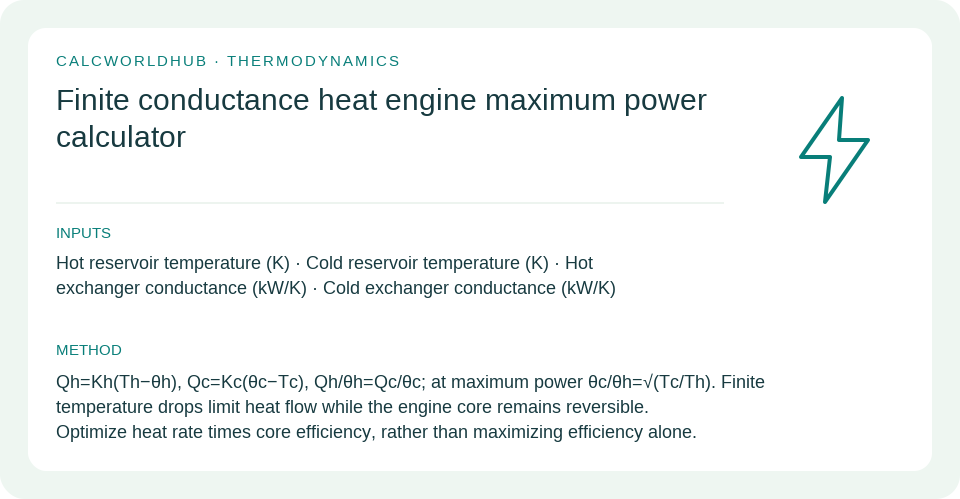
Qh=Kh(Th−θh), Qc=Kc(θc−Tc), Qh/θh=Qc/θc; at maximum power θc/θh=√(Tc/Th).
Finite temperature drops limit heat flow while the engine core remains reversible. Optimize heat rate times core efficiency, rather than maximizing efficiency alone.
A worked scenario
Hot reservoir temperature (K) = 600; Cold reservoir temperature (K) = 300; Hot exchanger conductance (kW/K) = 2; Cold exchanger conductance (kW/K) = 3.
- Maximum model power: 61.766235 kW
- Efficiency at maximum power: 29.289322 %
- Internal hot isotherm: 494.558441 K
- Internal cold isotherm: 349.705627 K
Hot and cold reservoirs at 600 and 300 K connect through conductances 2 and 3 kW/K. Maximum model power is 61.7662 kW at internal temperatures 494.558 and 349.706 K; the optimum efficiency is 29.2893%, below the reservoir Carnot limit.
Assumptions and edge cases
Endoreversible steady model with Newtonian heat transfer and no heat leak or mechanical dissipation. The square-root efficiency is specific to these assumptions and is not a universal bound for real engines.
Reading the outputs
Maximum power is kW; efficiency is percent; internal isothermal temperatures differ from reservoir temperatures.
Frequently asked questions
Does this replace Carnot efficiency?
No. Carnot is a reversible reservoir bound; this optimizes finite-power operation for a particular heat-transfer model.
Why can different conductances give the same optimum efficiency?
They change internal temperatures and heat rate; the optimized temperature ratio still has the same square-root form here.
Can real engine power exceed this calculated value?
Yes if its area, conductances or physical model differ; it is not a universal equipment limit.
How do I use the Finite conductance heat engine maximum power calculator?
Enter Hot reservoir temperature (K), Cold reservoir temperature (K), Hot exchanger conductance (kW/K), Cold exchanger conductance (kW/K). Match the units shown beside each field and review the result together with the assumptions below.
What is a worked example of Finite conductance heat engine maximum power?
Hot reservoir temperature (K) = 600; Cold reservoir temperature (K) = 300; Hot exchanger conductance (kW/K) = 2; Cold exchanger conductance (kW/K) = 3. Maximum model power: 61.766235 kW Efficiency at maximum power: 29.289322 % Internal hot isotherm: 494.558441 K Internal cold isotherm: 349.705627 K Hot and cold reservoirs at 600 and 300 K connect through conductances 2 and 3 kW/K. Maximum model power is 61.7662 kW at internal temperatures 494.558 and 349.706 K; the optimum efficiency is 29.2893%, below the reservoir Carnot limit.
Background or definition reference: Research on the model-specific nature of Curzon–Ahlborn efficiency.
Read our calculation methodology.