Finite population sample size calculator
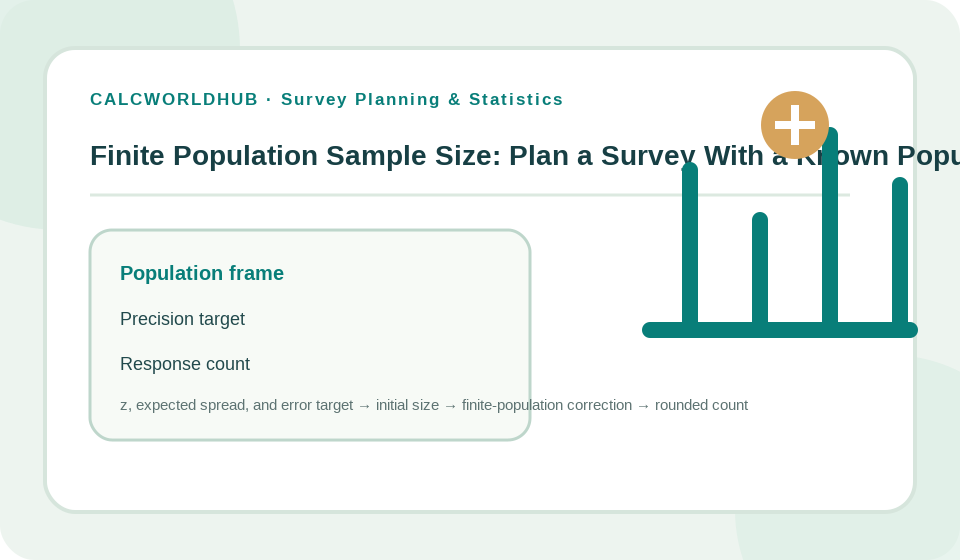
First estimate the sample size for a mean, then apply finite-population correction for a known population. The result is rounded up to a whole person or item.
Calculator
How to use this calculator
Estimate a rounded-up sample size for a mean from standard deviation, confidence z value, margin of error, and known population size.
- Sample standard deviation s Confidence z multiplier z Target margin of error E Population size N
- Read the worked example below to check the expected input format and result.
- Compare another scenario by changing one input at a time. Use Reset to return to the starting values.
Finite population sample size calculator
First estimate the sample size for a mean, then apply finite-population correction for a known population. The result is rounded up to a whole person or item.
Inputs and units
- Sample standard deviation s
- Confidence z multiplier z
- Target margin of error E
- Population size N
Formula and method
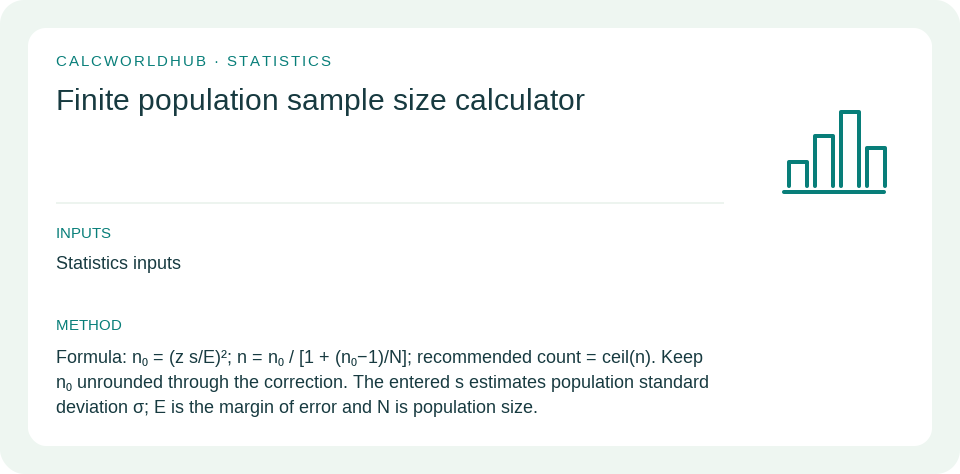
Formula: n₀ = (z s/E)²; n = n₀ / [1 + (n₀−1)/N]; recommended count = ceil(n). Keep n₀ unrounded through the correction. The entered s estimates population standard deviation σ; E is the margin of error and N is population size.
Worked example
With s = 12, z = 1.96, E = 2, and N = 2,000: n₀ = 138.2976; corrected n ≈ 129.414; round up the final recommendation to 130 observations.
Interpreting the result
Finite correction matters when the sample is a meaningful fraction of a known population. The output is a planning estimate for a mean; only the final corrected estimate is rounded up.
Assumptions and limits
This is not a proportion-design calculator and does not address nonresponse, clustering, stratification, bias, or a t-based estimate for an unknown population standard deviation. Sampling method still determines representativeness.
Sources and method notes
- UF IFAS gives the sample-size formula for a mean and the finite-population adjustment. This calculator uses s as an estimate of population σ and rounds only the corrected result. University of Florida IFAS Extension: Determining Sample Size
Frequently asked questions
Why is the final sample size rounded up?
A study cannot collect a fraction of an observation, and rounding down could fall short of the calculated requirement.
Why was ‘sample size n’ removed?
The formula derives an initial size from s, z, and E; the old n field did not affect the output.
How do I use the Finite population sample size calculator?
Sample standard deviation s Confidence z multiplier z Target margin of error E Population size N
What is a worked example of Finite population sample size?
With s = 12, z = 1.96, E = 2, and N = 2,000: n₀ = 138.2976; corrected n ≈ 129.414; round up the final recommendation to 130 observations.
What does the Finite population sample size calculator calculate?
Estimate a rounded-up sample size for a mean from standard deviation, confidence z value, margin of error, and known population size.
See the calculation methodology.
Good calculators show their work.
CalcWorldHub is built around clear inputs and visible assumptions. Results are estimates for planning; check official sources or your provider’s terms when exact figures matter.