First-order reaction concentration calculator
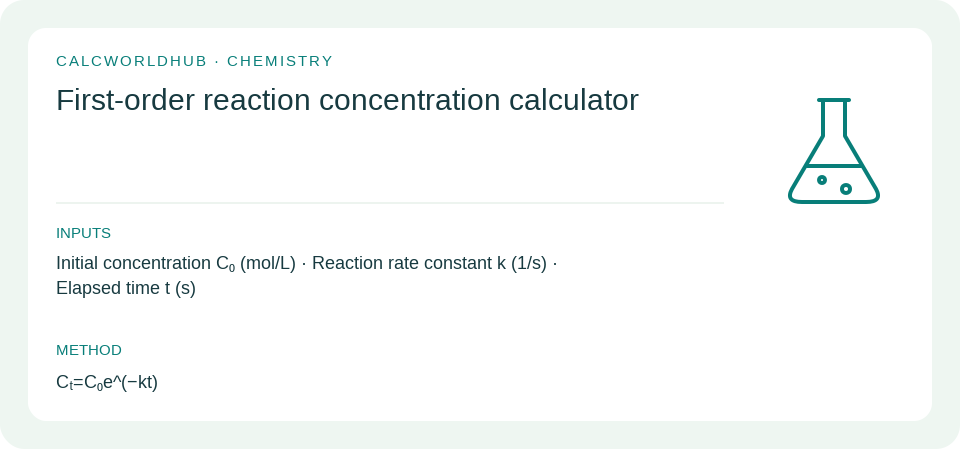
Predict remaining concentration under a first-order decay model.
Calculator
How to use this calculator
Predict remaining concentration under a first-order decay model.
- Enter Initial concentration C₀ (mol/L), Reaction rate constant k (1/s), Elapsed time t (s). Match the units shown beside each field and review the result together with the assumptions below.
- Read the worked example below to check the expected input format and result.
- Compare another scenario by changing one input at a time. Use Reset to return to the starting values.
First-order reaction concentration calculator
Predict remaining concentration under a first-order decay model.
Inputs and units
- Initial concentration C₀ (mol/L): Starting reactant concentration at t=0, on the same concentration scale as the final value.
- Reaction rate constant k (1/s): First-order rate constant k; its inverse time unit must match the elapsed-time unit.
- Elapsed time t (s): Time between the initial and final concentration measurements, using the time unit paired with k.
Formula and method
Cₜ=C₀e^(−kt)
Worked example
With C₀=0.8 mol/L, k=0.15 s⁻¹, and t=6 s, Cₜ=0.8e^(−0.9)=0.3253 mol/L.
Interpreting the result
Concentration approaches zero asymptotically; the fraction remaining is independent of the starting concentration.
Assumptions and limits
C₀ must be nonnegative and k,t nonnegative; time and rate units must be reciprocal. Assumes constant first-order kinetics.
Sources and method
- Gives [A]t=[A]₀e^(−kt) and its logarithmic rearrangements. OpenStax Chemistry 2e: integrated rate laws
Frequently asked questions
Which inputs determine this result?
The visible inputs are Initial concentration C₀ (mol/L), Reaction rate constant k (1/s), Elapsed time t (s). Each is used by the displayed formula; the calculator does not use any other hidden measurement.
When does this method apply?
C₀ must be nonnegative and k,t nonnegative; time and rate units must be reciprocal. Assumes constant first-order kinetics.
How do I use the First-order reaction concentration calculator?
Enter Initial concentration C₀ (mol/L), Reaction rate constant k (1/s), Elapsed time t (s). Match the units shown beside each field and review the result together with the assumptions below.
What is a worked example of First-order reaction concentration?
With C₀=0.8 mol/L, k=0.15 s⁻¹, and t=6 s, Cₜ=0.8e^(−0.9)=0.3253 mol/L.
What does the First-order reaction concentration calculator calculate?
Predict remaining concentration under a first-order decay model.
See the calculation methodology.
Good calculators show their work.
CalcWorldHub is built around clear inputs and visible assumptions. Results are estimates for planning; check official sources or your provider’s terms when exact figures matter.