How to use this calculator
Estimate ideal flat-belt traction power while including centrifugal tension in the total tight-side tension limit.
- Enter Allowed total tight-side tension (N), Belt pulley friction coefficient, Contact wrap angle (degrees), Belt linear speed (m/s), then complete the remaining labeled fields. Match the units shown beside each field and review the result together with the assumptions below.
- Read the worked example below to check the expected input format and result.
- Compare another scenario by changing one input at a time. Use Reset to return to the starting values.
Flat belt power with centrifugal tension explained
The model reserves centrifugal tension first, then estimates the remaining friction-limited belt force and ideal power.
How the calculation works
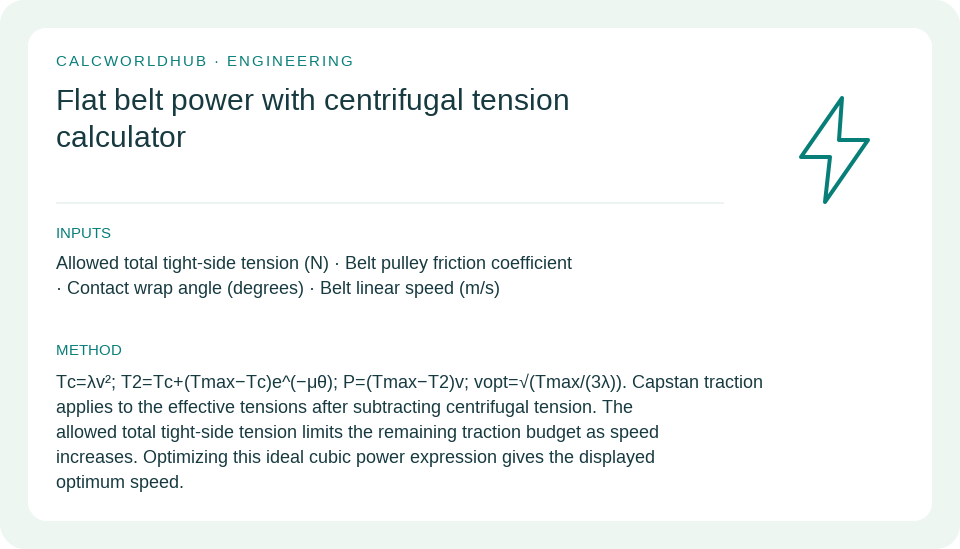
Tc=λv²; T2=Tc+(Tmax−Tc)e^(−μθ); P=(Tmax−T2)v; vopt=√(Tmax/(3λ)).
Capstan traction applies to the effective tensions after subtracting centrifugal tension. The allowed total tight-side tension limits the remaining traction budget as speed increases. Optimizing this ideal cubic power expression gives the displayed optimum speed.
Set up the calculation
T— Allowed total tight-side tension (N)- Allowed total tight-side belt tension, including centrifugal tension, in newtons.
mu— Belt pulley friction coefficient- Belt pulley friction coefficient. This is a dimensionless model parameter unless the label explicitly states a unit.
theta— Contact wrap angle (degrees)- Angle in degrees, converted internally to radians.
v— Belt linear speed (m/s)- Signed speed component or speed magnitude in metres per second, as labeled.
lambda— Belt mass per length (kg/m)- Moving belt mass per length in kg/m. It determines centrifugal tension lambda times speed squared.
Limits of this model
Flat flexible belt, constant friction, uniform linear mass, fixed wrap angle, and steady motion. No V-belt wedging, bending loss, fatigue rating, dynamic tension, or manufacturer service factors. Centrifugal tension must stay below the total limit.
Check this example
Allowed total tight-side tension (N) = 900; Belt pulley friction coefficient = 0.3; Contact wrap angle (degrees) = 170; Belt linear speed (m/s) = 18; Belt mass per length (kg/m) = 0.45.
- Ideal transmissible belt power: 8.00135911 kW
- Centrifugal tension: 145.8 N
- Total slack-side tension at traction limit: 455.48004956 N
- Speed maximizing this ideal power model: 25.81988897 m/s
At eighteen metres per second, the moving belt already consumes part of the nine-hundred-newton tension budget before transmitting useful torque.
Reading the outputs
Power is an ideal traction limit, not a selected belt drive rating. The mathematical optimum can exceed practical pulley or belt speed limits.
Frequently asked questions
Is theta entered in radians?
Enter degrees; the exponential uses the converted radian angle.
Can I use V-belt data unchanged?
No. Groove wedging changes the traction model.
Why can faster belts transmit less power?
Centrifugal tension grows as speed squared and reduces the usable tension difference.
How do I use the Flat belt power with centrifugal tension calculator?
Enter Allowed total tight-side tension (N), Belt pulley friction coefficient, Contact wrap angle (degrees), Belt linear speed (m/s), then complete the remaining labeled fields. Match the units shown beside each field and review the result together with the assumptions below.
What is a worked example of Flat belt power with centrifugal tension?
Allowed total tight-side tension (N) = 900; Belt pulley friction coefficient = 0.3; Contact wrap angle (degrees) = 170; Belt linear speed (m/s) = 18; Belt mass per length (kg/m) = 0.45. Ideal transmissible belt power: 8.00135911 kW Centrifugal tension: 145.8 N Total slack-side tension at traction limit: 455.48004956 N Speed maximizing this ideal power model: 25.81988897 m/s At eighteen metres per second, the moving belt already consumes part of the nine-hundred-newton tension budget before transmitting useful torque.
Read our calculation methodology.