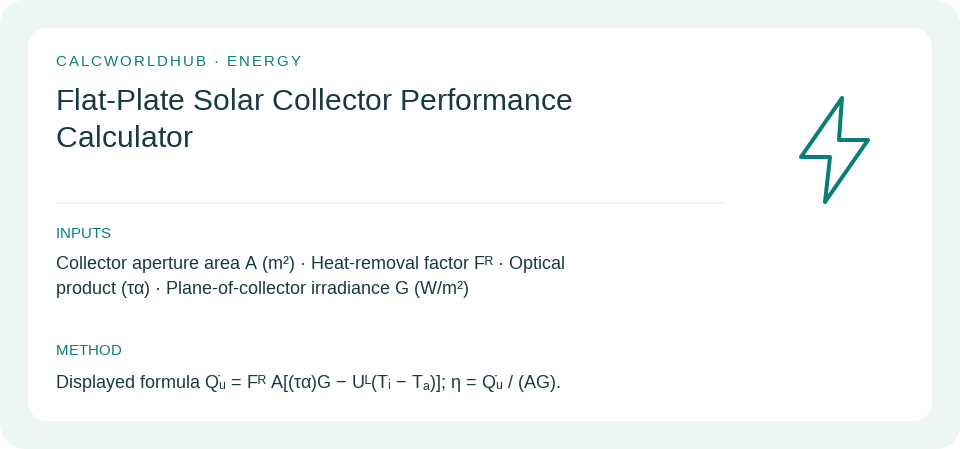
How to use this calculator
Estimate useful heat rate and instantaneous efficiency with the Hottel–Whillier–Bliss collector model.
- Enter Collector aperture area A (m²), Heat-removal factor Fᴿ, Optical product (τα), Plane-of-collector irradiance G (W/m²), then complete the remaining labeled fields. Match the units shown beside each field and review the result together with the assumptions below.
- Read the worked example below to check the expected input format and result.
- Compare another scenario by changing one input at a time. Use Reset to return to the starting values.
How this calculation works
The Hottel–Whillier–Bliss relation balances absorbed solar irradiance against collector heat loss at the fluid inlet temperature. The result is a steady-state estimate for a flat-plate collector with entered test or design coefficients.
Inputs and units
area— Collector aperture area A (m²)- Aperture area used by the collector-performance model.
heatRemoval— Heat-removal factor Fᴿ- Dimensionless heat-removal factor from a collector test or model.
opticalProduct— Optical product (τα)- Transmittance–absorptance product for the collector.
irradiance— Plane-of-collector irradiance G (W/m²)- Solar irradiance incident on the collector plane.
lossCoefficient— Overall loss coefficient Uᴸ (W/m²·K)- Collector heat-loss coefficient per aperture area.
inletTemperature— Fluid inlet temperature Tᵢ (°C)- Fluid temperature entering the collector.
ambientTemperature— Ambient temperature Tₐ (°C)- Ambient air temperature around the collector.
Formula
Q̇ᵤ = Fᴿ A[(τα)G − Uᴸ(Tᵢ − Tₐ)]; η = Q̇ᵤ / (AG).
Method
Compute absorbed solar power per aperture area, subtract the inlet-to-ambient loss term, multiply by collector area and heat-removal factor, then divide useful heat rate by incident solar power for efficiency.
Worked example
For A = 2.00 m², Fᴿ = 0.85, (τα) = 0.75, G = 800 W/m², Uᴸ = 4 W/(m²·K), Tᵢ = 50 °C, and Tₐ = 20 °C, Q̇ᵤ = 816 W and η = 51.0%.
Assumptions and limits
Use irradiance on the collector plane and compatible SI inputs. This is an instantaneous collector model with constant optical and loss coefficients; it excludes piping, storage, controls, shading, and whole-system losses. A negative net result means losses exceed useful gain under the entered conditions.
Frequently asked questions
What is the heat-removal factor?
It accounts for the collector heat-transfer effectiveness relative to a collector surface at the fluid inlet temperature.
Can useful heat rate be negative?
Yes. If heat losses exceed absorbed solar power at the entered temperatures, the model reports a net loss.
Is this whole-system solar-water-heating efficiency?
No. It estimates the collector itself at one operating point and omits storage, piping, controls, and system losses.
How do I use the Flat-Plate Solar Collector Performance Calculator?
Enter Collector aperture area A (m²), Heat-removal factor Fᴿ, Optical product (τα), Plane-of-collector irradiance G (W/m²), then complete the remaining labeled fields. Match the units shown beside each field and review the result together with the assumptions below.
What is a worked example of Flat-Plate Solar Collector Performance?
For A = 2.00 m², Fᴿ = 0.85, (τα) = 0.75, G = 800 W/m², Uᴸ = 4 W/(m²·K), Tᵢ = 50 °C, and Tₐ = 20 °C, Q̇ᵤ = 816 W and η = 51.0%.
Reference: ASHRAE Handbook flat-plate collector Hottel–Whillier–Bliss performance method. See our calculation methodology.