How to use this calculator
Measure chance-corrected nominal agreement when several raters classify the same items.
- Enter Per-item category counts (rows separated by semicolons). Match the units shown beside each field and review the result together with the assumptions below.
- Read the worked example below to check the expected input format and result.
- Compare another scenario by changing one input at a time. Use Reset to return to the starting values.
How this calculation works
Fleiss’ kappa uses a table of category counts per item rather than requiring the identity of each rater. Every item must have the same number of ratings and the same categories. The statistic compares observed agreement with agreement expected from the pooled category frequencies.
Inputs and units
matrix— Per-item category counts (rows separated by semicolons)- Example: 4,1,0 means four ratings in category 1, one in category 2, none in category 3.
Formula
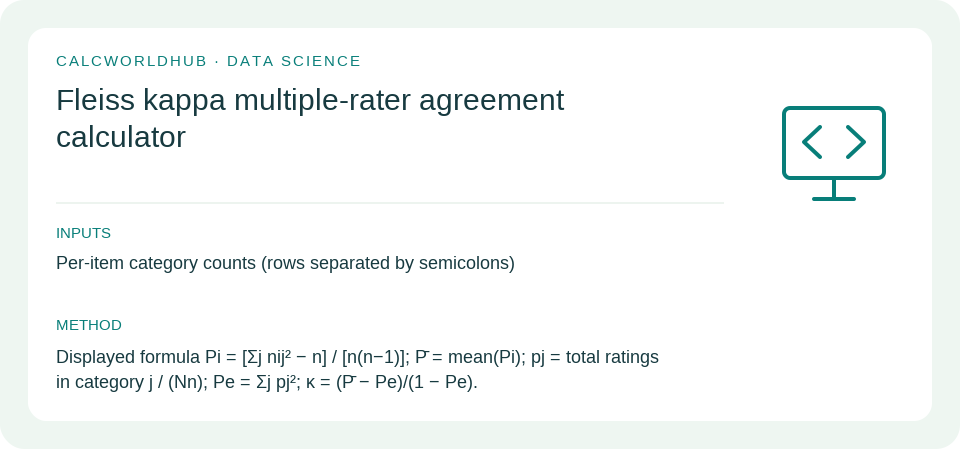
Pi = [Σj nij² − n] / [n(n−1)]; P̄ = mean(Pi); pj = total ratings in category j / (Nn); Pe = Σj pj²; κ = (P̄ − Pe)/(1 − Pe).
Method
Enter one row per rated item. Within each row, enter the count of ratings for each category, separated by commas; separate rows with semicolons. All rows must contain the same number of categories and sum to the same number of raters.
Worked example
For rows (4,1,0), (3,2,0), and (0,1,4), five raters classify each item. Mean observed agreement is 0.5333, chance agreement is 0.36, and Fleiss’ κ is about 0.2708.
Assumptions and limits
This is the nominal-scale Fleiss statistic for complete, equally sized rating sets. It does not handle ordinal category distances, missing ratings, rater-specific weighting, confidence intervals, or significance tests. Kappa is undefined when expected agreement is exactly one.
Frequently asked questions
How many raters are needed?
Each row needs at least two ratings, and every item must have the same number of raters for this implementation.
Can I use ordered categories such as poor, fair, and good?
This version treats categories as nominal and does not give partial credit for nearby ordered ratings.
Do I enter individual ratings or counts?
Enter counts by category for each item. A row such as 4,1,0 summarizes five ratings across three categories.
Why might kappa be undefined?
If all pooled ratings fall in one category, expected agreement can equal one and the denominator becomes zero.
How do I use the Fleiss kappa multiple-rater agreement calculator?
Enter Per-item category counts (rows separated by semicolons). Match the units shown beside each field and review the result together with the assumptions below.
Reference: Joseph Fleiss, original nominal-scale agreement method for multiple raters. See our calculation methodology.