How to use this calculator
Estimate Flesch Reading Ease and U.S. grade level from word, sentence, and syllable counts.
- Enter Words, Sentences, Syllables. Match the units shown beside each field and review the result together with the assumptions below.
- Read the worked example below to check the expected input format and result.
- Compare another scenario by changing one input at a time. Use Reset to return to the starting values.
How this calculation works
The Flesch Reading Ease and Flesch-Kincaid Grade Level formulas use average words per sentence and average syllables per word. This calculator accepts counts you have already measured; it does not analyze text or count syllables automatically.
Inputs and units
wordCount— Words- Total words in the passage under one consistent counting method.
sentenceCount— Sentences- Total complete sentences counted in the same passage.
syllableCount— Syllables- Total syllables counted across the same words.
Formula
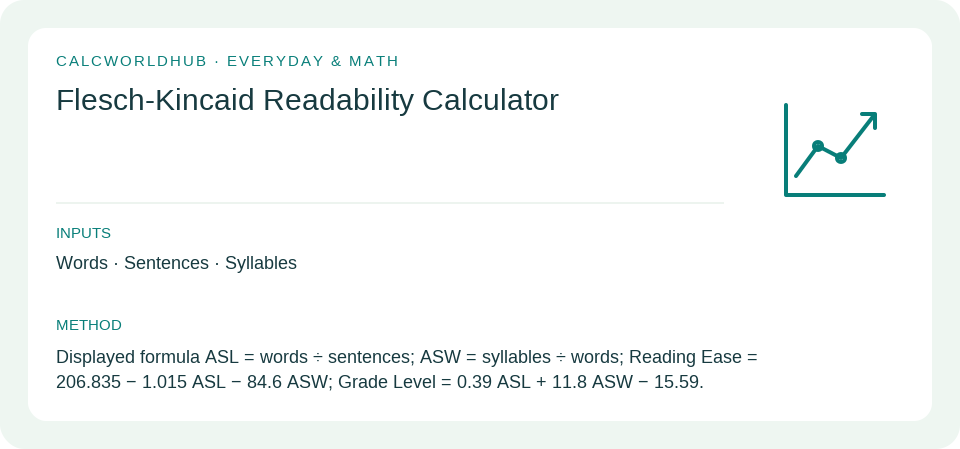
ASL = words ÷ sentences; ASW = syllables ÷ words; Reading Ease = 206.835 − 1.015 ASL − 84.6 ASW; Grade Level = 0.39 ASL + 11.8 ASW − 15.59.
Method
Enter the total word, sentence, and syllable counts for one passage. The formulas compute average sentence length and average syllables per word, then report both readability scores.
Worked example
A passage with 100 words, 5 sentences, and 150 syllables has a Flesch Reading Ease score of 59.64 and a Flesch-Kincaid Grade Level of 9.91.
Assumptions and limits
These English-language formulas are rough text-level indicators, not measures of comprehension or audience knowledge. Results depend on how words, sentences, and syllables are counted; they do not account for layout, subject knowledge, images, or document context. Grade-level results can be negative or decimal.
Frequently asked questions
Does this calculate syllables from pasted text?
No. Enter counts measured from the passage; automatic syllable counting is outside this calculator.
What does a higher Reading Ease score mean?
The score is on a 100-point scale; higher values indicate easier text under this formula.
Can a grade-level result be negative?
Yes. Short, low-syllable sentences can produce a negative value under the formula.
How do I use the Flesch-Kincaid Readability Calculator?
Enter Words, Sentences, Syllables. Match the units shown beside each field and review the result together with the assumptions below.
What is a worked example of Flesch-Kincaid Readability?
A passage with 100 words, 5 sentences, and 150 syllables has a Flesch Reading Ease score of 59.64 and a Flesch-Kincaid Grade Level of 9.91.
Reference: Microsoft Support documentation of Flesch Reading Ease and Flesch-Kincaid grade-level equations. See our calculation methodology.