Flywheel inertia from a cyclic torque curve calculator
Estimate ideal flywheel inertia from a periodic torque curve, allowed speed fluctuation, and mean rotational speed.
How to use this calculator
Estimate ideal flywheel inertia from a periodic torque curve, allowed speed fluctuation, and mean rotational speed.
- Enter Equally spaced periodic torque samples (N m), Mean speed (rpm), Allowed speed fluctuation coefficient. Match the units shown beside each field and review the result together with the assumptions below.
- Read the worked example below to check the expected input format and result.
- Compare another scenario by changing one input at a time. Use Reset to return to the starting values.
How the Flywheel inertia from a cyclic torque curve calculator works
Estimate ideal flywheel inertia from a periodic torque curve, allowed speed fluctuation, and mean rotational speed.
Inputs and units
- Equally spaced periodic torque samples (N m): Equally spaced torque samples in N m for one cycle; signed torque is valid and the first sample must not be repeated at the end.
- Mean speed (rpm): Positive mean rotational speed in rpm, converted to radians/second.
- Allowed speed fluctuation coefficient: Dimensionless (maximum−minimum)/mean speed; enter 0.04 for 4%, not 4.
Formula and method
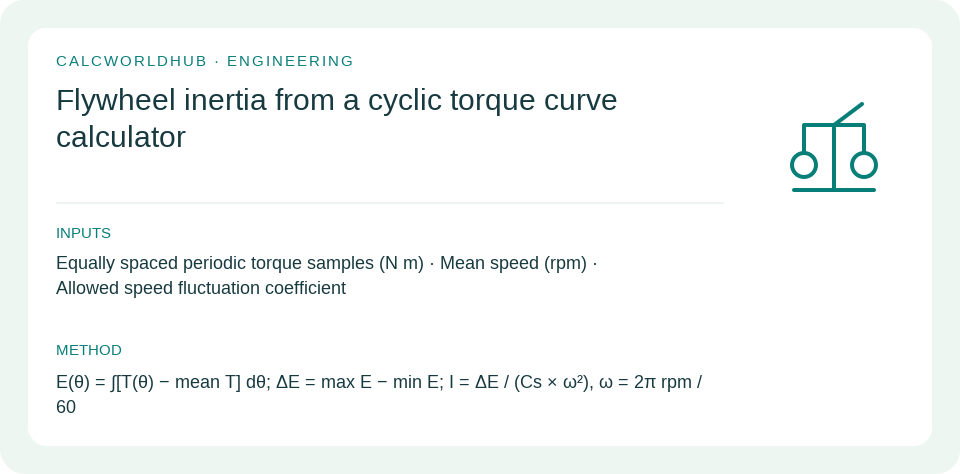
E(θ) = ∫[T(θ) − mean T] dθ; ΔE = max E − min E; I = ΔE / (Cs × ω²), ω = 2π rpm / 60
Worked example
For torque samples 40,90,120,50,−20,−30,0,30 N m, mean torque is 35 N m. Periodic linear integration gives ΔE = 120.053719 J. At 600 rpm and Cs = 0.04, I = 0.760249 kg m².
Interpreting the result
The inertia is the total ideal rotational inertia required to limit cyclic speed variation under the entered torque profile. Existing rotating inertia can contribute to that total.
Assumptions and limits
Samples are equally spaced over one revolution, linked linearly including last-to-first. Interior zero crossings of excess torque are included when finding energy extrema. Constant resisting torque, rigid rotation, and no losses are assumed.
Sources and method
- Relates cyclic energy fluctuation, inertia, mean speed, and speed fluctuation coefficient. NPTEL: flywheel
Frequently asked questions
Can a negative torque sample be valid?
Yes. A portion of the cycle may oppose rotation; the calculation integrates torque relative to the cycle mean.
What if torque is constant through the cycle?
Excess torque is zero throughout, so the cyclic energy fluctuation and ideal additional inertia requirement are zero.
How do I use the Flywheel inertia from a cyclic torque curve calculator?
Enter Equally spaced periodic torque samples (N m), Mean speed (rpm), Allowed speed fluctuation coefficient. Match the units shown beside each field and review the result together with the assumptions below.
What is a worked example of Flywheel inertia from a cyclic torque curve?
For torque samples 40,90,120,50,−20,−30,0,30 N m, mean torque is 35 N m. Periodic linear integration gives ΔE = 120.053719 J. At 600 rpm and Cs = 0.04, I = 0.760249 kg m².
What does the Flywheel inertia from a cyclic torque curve calculator calculate?
Estimate ideal flywheel inertia from a periodic torque curve, allowed speed fluctuation, and mean rotational speed.
See the calculation methodology.