How to use this calculator
Compute a reproducible noncryptographic 32-bit hash of UTF-8 text.
- Enter Text encoded as UTF-8. Match the units shown beside each field and review the result together with the assumptions below.
- Read the worked example below to check the expected input format and result.
- Compare another scenario by changing one input at a time. Use Reset to return to the starting values.
FNV 1a 32 bit text hash explained
FNV-1a hashes the UTF-8 bytes of the entered text into 32 bits, so visually similar Unicode strings can differ when their byte encodings differ.
How the calculation works
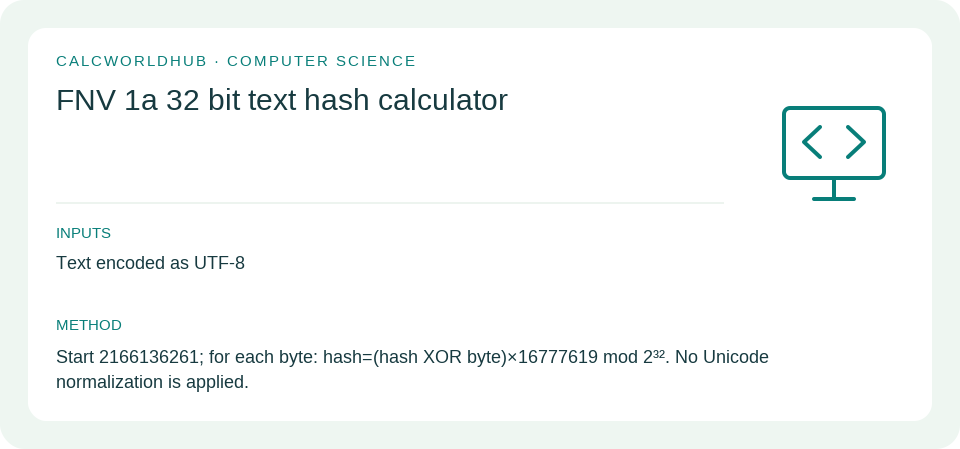
Start 2166136261; for each byte: hash=(hash XOR byte)×16777619 mod 2³².
No Unicode normalization is applied.
Set up the calculation
s— Text encoded as UTF-8- Text encoded as UTF-8. An empty string is a valid byte sequence.
Limits of this model
No Unicode normalization is applied. FNV is not suitable for password storage or adversarial integrity protection.
Check this example
Text encoded as UTF-8 = hello.
- FNV-1a 32-bit hash: 4f9f2cab hex
Interpreting the result
The output is a 32-bit hexadecimal hash of the exact UTF-8 bytes. It is a non-cryptographic checksum for hashing or indexing, not a collision-resistant security primitive.
Frequently asked questions
Does whitespace count?
Yes, every encoded byte participates.
Are visually identical Unicode forms equal?
Not unless their bytes match.
Is this encryption?
No.
How do I use the FNV 1a 32 bit text hash calculator?
Enter Text encoded as UTF-8. Match the units shown beside each field and review the result together with the assumptions below.
What is a worked example of FNV 1a 32 bit text hash?
Text encoded as UTF-8 = hello. FNV-1a 32-bit hash: 4f9f2cab hex
Method reference: RFC 9923 FNV algorithm.