Food energy density calculator
Estimate calories per gram from carbohydrate, protein, fat, and serving mass using general Atwater factors.
Calculator
How to use this calculator
Estimate calories per gram from carbohydrate, protein, fat, and serving mass using general Atwater factors.
- Enter Carbohydrate (g), Protein (g), Fat (g), Serving mass (g). Match the units shown beside each field and review the result together with the assumptions below.
- Read the worked example below to check the expected input format and result.
- Compare another scenario by changing one input at a time. Use Reset to return to the starting values.
Food energy density calculator
Estimate calories per gram from carbohydrate, protein, fat, and serving mass using general Atwater factors.
Inputs and units
- Carbohydrate (g): Mass of this macronutrient in the serving; Atwater factors estimate its energy contribution.
- Protein (g): Mass of this macronutrient in the serving; Atwater factors estimate its energy contribution.
- Fat (g): Mass of this macronutrient in the serving; Atwater factors estimate its energy contribution.
- Serving mass (g): Total edible serving mass in grams; energy density divides macro calories by this mass.
Formula and method
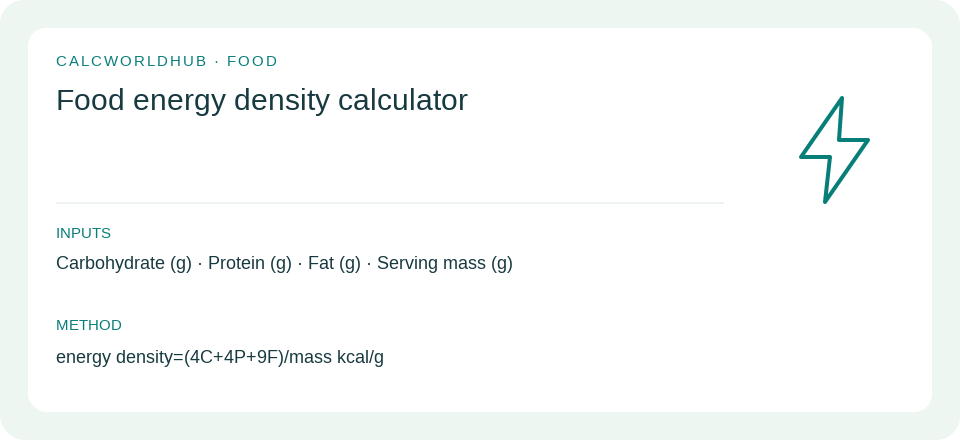
energy density=(4C+4P+9F)/mass kcal/g
Worked example
45 g carbohydrate, 25 g protein, 12 g fat in a 180 g serving gives (180+100+108)/180=2.1556 kcal/g.
Interpreting the result
This is a macro-based estimate; label energy can differ because of fiber, polyols, rounding, and jurisdiction-specific factors.
Assumptions and limits
Macro masses must be nonnegative and serving mass positive; do not enter calories in the gram fields.
Sources and method
- Documents general Atwater factors and differences from specific factors and label calculations. USDA FoodData Central: Foundation Foods documentation
Frequently asked questions
Which inputs determine this result?
The visible inputs are Carbohydrate (g), Protein (g), Fat (g), Serving mass (g). Each is used by the displayed formula; the calculator does not use any other hidden measurement.
When does this method apply?
Macro masses must be nonnegative and serving mass positive; do not enter calories in the gram fields.
How do I use the Food energy density calculator?
Enter Carbohydrate (g), Protein (g), Fat (g), Serving mass (g). Match the units shown beside each field and review the result together with the assumptions below.
What is a worked example of Food energy density?
45 g carbohydrate, 25 g protein, 12 g fat in a 180 g serving gives (180+100+108)/180=2.1556 kcal/g.
What does the Food energy density calculator calculate?
Estimate calories per gram from carbohydrate, protein, fat, and serving mass using general Atwater factors.
See the calculation methodology.
Good calculators show their work.
CalcWorldHub is built around clear inputs and visible assumptions. Results are estimates for planning; check official sources or your provider’s terms when exact figures matter.