How to use this calculator
Estimate tilt-adjusted angular distortion from two settlement readings, their spacing, and an entered rigid-body tilt.
- Enter Support A settlement (mm), Support B settlement (mm), Support spacing (m), Rigid-body tilt (mm/m). Match the units shown beside each field and review the result together with the assumptions below.
- Read the worked example below to check the expected input format and result.
- Compare another scenario by changing one input at a time. Use Reset to return to the starting values.
Subtract overall tilt from the slope between two settlement points
This two-point model estimates residual angular distortion from differential settlement after subtracting an entered rigid-body tilt. Both settlement readings must share a datum and sign convention.
Inputs and units
- Support A settlement (mm): Signed downward-positive movement at the first support.
- Support B settlement (mm): Signed downward-positive movement at the second support, using the same datum.
- Support spacing (m): Horizontal distance between the two observation points.
- Rigid-body tilt (mm/m): Signed overall slope to subtract from the measured relative settlement slope.
Formula and method
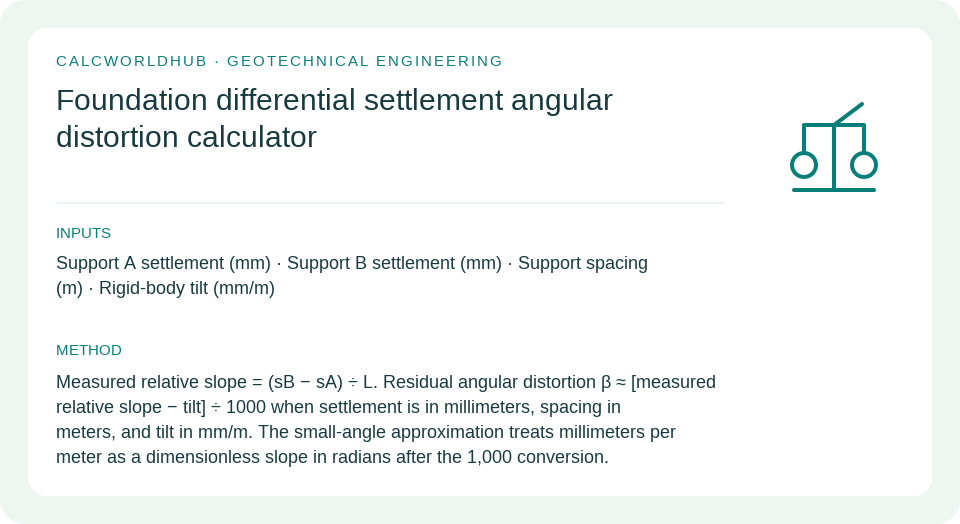
Measured relative slope = (sB − sA) ÷ L. Residual angular distortion β ≈ [measured relative slope − tilt] ÷ 1000 when settlement is in millimeters, spacing in meters, and tilt in mm/m. The small-angle approximation treats millimeters per meter as a dimensionless slope in radians after the 1,000 conversion.
Worked example
For sA = 12 mm, sB = 28 mm, and L = 8 m, the relative slope is (28 − 12)/8 = 2 mm/m. Subtracting 0.5 mm/m of entered rigid-body tilt leaves 1.5 mm/m, so β ≈ 1.5/1,000 = 0.0015 rad.
Interpreting the result
The result is the signed, tilt-adjusted slope under the entered two-point model. It does not establish structural damage, strain, curvature, or whether a building is safe.
Assumptions and limits
Two readings cannot describe the settlement profile between supports or the response of the superstructure. Acceptable distortion depends on foundation, soil, structural form, materials, and use. This educational calculation is not a code-compliant design check or an engineering assessment.
Method references
- University of the West of England: geotechnical foundations glossary
- Hong Kong University of Science and Technology: tolerable settlement and angular distortion
Frequently asked questions
Why subtract rigid-body tilt?
A structure can rotate as a whole without the same internal distortion as differential bending. The entered tilt is removed from the measured support-to-support slope to estimate the residual under this model.
How do I use the Foundation differential settlement angular distortion calculator?
Enter Support A settlement (mm), Support B settlement (mm), Support spacing (m), Rigid-body tilt (mm/m). Match the units shown beside each field and review the result together with the assumptions below.
What is a worked example of Foundation differential settlement angular distortion?
For sA = 12 mm, sB = 28 mm, and L = 8 m, the relative slope is (28 − 12)/8 = 2 mm/m. Subtracting 0.5 mm/m of entered rigid-body tilt leaves 1.5 mm/m, so β ≈ 1.5/1,000 = 0.0015 rad.
What does the Foundation differential settlement angular distortion calculator calculate?
Estimate tilt-adjusted angular distortion from two settlement readings, their spacing, and an entered rigid-body tilt.
What assumptions apply to Foundation differential settlement angular distortion?
Two readings cannot describe the settlement profile between supports or the response of the superstructure. Acceptable distortion depends on foundation, soil, structural form, materials, and use. This educational calculation is not a code-compliant design check or an engineering assessment.