Four-value skewness calculator
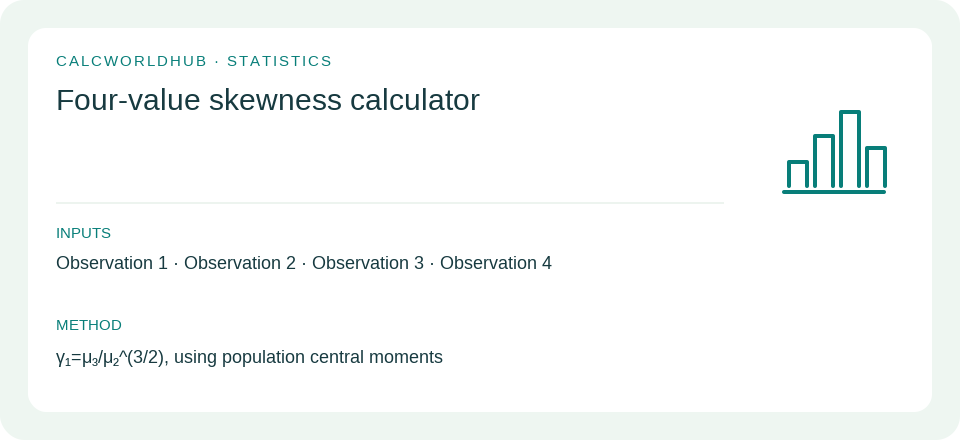
Summarize asymmetry for four equally weighted observations with the standardized third central moment.
Calculator
How to use this calculator
Summarize asymmetry for four equally weighted observations with the standardized third central moment.
- Enter Observation 1, Observation 2, Observation 3, Observation 4. Match the units shown beside each field and review the result together with the assumptions below.
- Read the worked example below to check the expected input format and result.
- Compare another scenario by changing one input at a time. Use Reset to return to the starting values.
Four-value skewness calculator
Summarize asymmetry for four equally weighted observations with the standardized third central moment.
Inputs and units
- Observation 1: One of four equally weighted observations in this set; keep all four on the same scale and in the same units.
- Observation 2: One of four equally weighted observations in this set; keep all four on the same scale and in the same units.
- Observation 3: One of four equally weighted observations in this set; keep all four on the same scale and in the same units.
- Observation 4: One of four equally weighted observations in this set; keep all four on the same scale and in the same units.
Formula and method
γ₁=μ₃/μ₂^(3/2), using population central moments
Worked example
For 5, 8, 4, 9, the mean is 6.5; third deviations cancel in symmetric pairs, giving γ₁=0.
Interpreting the result
Positive skew indicates a longer right tail; negative skew indicates a longer left tail. The four-point estimate is sensitive to each observation.
Assumptions and limits
All four values are treated as the full four-value set; if all values are identical, variance is zero and skewness is undefined.
Sources and method
- Summarizes common measures of location and spread used to interpret four-observation summaries. OpenStax Introductory Statistics 2e: descriptive statistics
Frequently asked questions
Which inputs determine this result?
The visible inputs are Observation 1, Observation 2, Observation 3, Observation 4. Each is used by the displayed formula; the calculator does not use any other hidden measurement.
When does this method apply?
All four values are treated as the full four-value set; if all values are identical, variance is zero and skewness is undefined.
How do I use the Four-value skewness calculator?
Enter Observation 1, Observation 2, Observation 3, Observation 4. Match the units shown beside each field and review the result together with the assumptions below.
What is a worked example of Four-value skewness?
For 5, 8, 4, 9, the mean is 6.5; third deviations cancel in symmetric pairs, giving γ₁=0.
What does the Four-value skewness calculator calculate?
Summarize asymmetry for four equally weighted observations with the standardized third central moment.
See the calculation methodology.
Good calculators show their work.
CalcWorldHub is built around clear inputs and visible assumptions. Results are estimates for planning; check official sources or your provider’s terms when exact figures matter.