Frequency ratio from redshift calculator
Use the measured redshift of one spectral feature to compare its observed frequency with its rest frequency. Positive redshift lowers observed frequency.
Calculator
How to use this calculator
Calculate observed-to-rest frequency from redshift z, see a worked spectral example, and check the z > −1 limit.
- Redshift z
- Read the worked example below to check the expected input format and result.
- Compare another scenario by changing one input at a time. Use Reset to return to the starting values.
Frequency ratio from redshift calculator
Use the measured redshift of one spectral feature to compare its observed frequency with its rest frequency. Positive redshift lowers observed frequency.
Inputs and units
- Redshift z
Formula and method
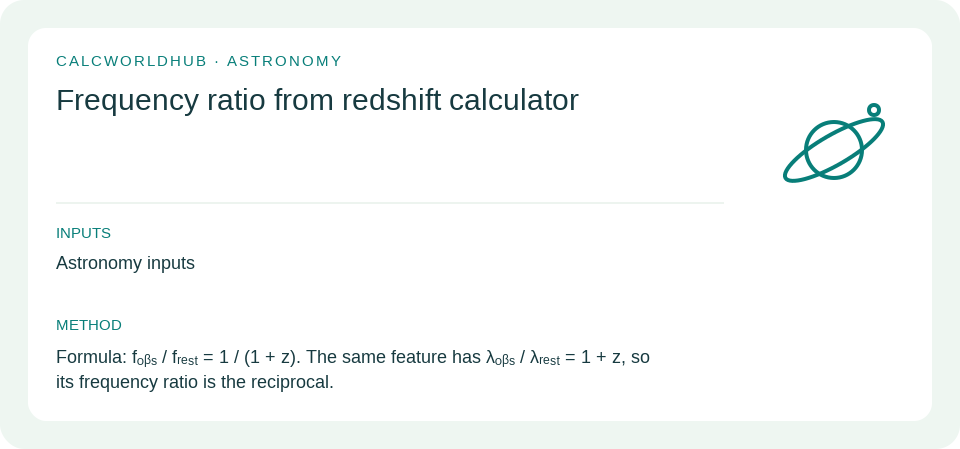
Formula: fₒᵦₛ / fᵣₑₛₜ = 1 / (1 + z). The same feature has λₒᵦₛ / λᵣₑₛₜ = 1 + z, so its frequency ratio is the reciprocal.
Worked example
For z = 0.02, the frequency ratio is 1 / 1.02 = 0.980392, displayed as 0.9804. The observed frequency is about 1.96% below the rest frequency.
Interpreting the result
A result below 1 means the observed frequency is lower; a value above 1 corresponds to a blueshift. The ratio has no frequency unit because the units cancel.
Assumptions and limits
This relation assumes the redshift convention for the same spectral feature and reference frame. It does not infer distance or separate cosmological, gravitational, and motion-related contributions to redshift.
Sources and method notes
- The wavelength of light shifts longer for redshift and shorter for blueshift; the page uses the standard z relation for the spectral feature. OpenStax Astronomy 2e: the Doppler effect
Frequently asked questions
Do I need both wavelengths?
No. The calculator uses redshift z only; wavelength inputs were removed because they did not affect the result.
Why must z be greater than −1?
The denominator 1 + z must stay positive for a positive wavelength and frequency ratio.
How do I use the Frequency ratio from redshift calculator?
Redshift z
What is a worked example of Frequency ratio from redshift?
For z = 0.02, the frequency ratio is 1 / 1.02 = 0.980392, displayed as 0.9804. The observed frequency is about 1.96% below the rest frequency.
What does the Frequency ratio from redshift calculator calculate?
Calculate observed-to-rest frequency from redshift z, see a worked spectral example, and check the z > −1 limit.
See the calculation methodology.
Good calculators show their work.
CalcWorldHub is built around clear inputs and visible assumptions. Results are estimates for planning; check official sources or your provider’s terms when exact figures matter.