How to use this calculator
Count hourly winter temperatures within the selected 32–45 °F chill-hour range.
- Enter Hourly winter temperature readings, Temperature unit. Match the units shown beside each field and review the result together with the assumptions below.
- Read the worked example below to check the expected input format and result.
- Compare another scenario by changing one input at a time. Use Reset to return to the starting values.
How this calculation works
Many deciduous fruit cultivars are described by a chilling requirement. This calculator applies one transparent chill-hours convention to a sequence of hourly temperature observations, making it possible to total the qualifying hours in a weather-station record without treating daily averages as hourly data.
Inputs and units
hourlyTemps— Hourly winter temperature readings- Enter one numeric reading for each hour. Do not paste daily highs, lows, or averages.
tempUnit— Temperature unit- Choose the unit used by every observation in the list.
Formula
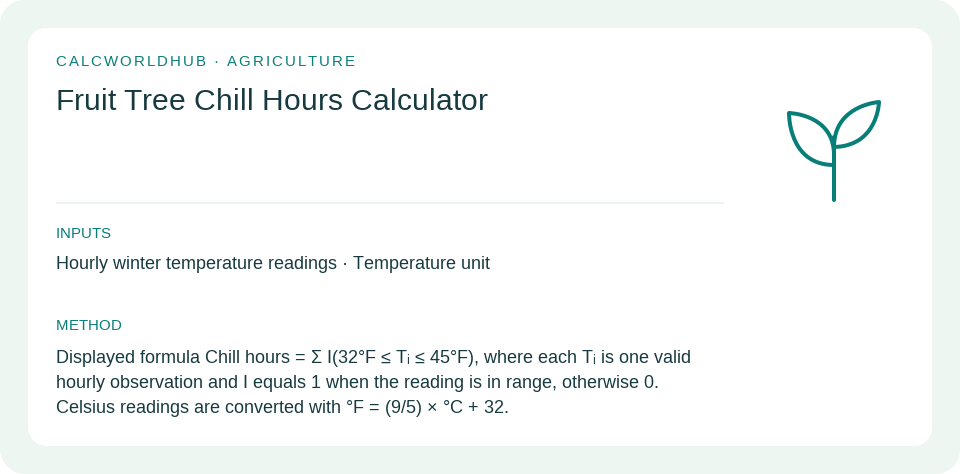
Chill hours = Σ I(32°F ≤ Tᵢ ≤ 45°F), where each Tᵢ is one valid hourly observation and I equals 1 when the reading is in range, otherwise 0. Celsius readings are converted with °F = (9/5) × °C + 32.
Method
Paste one air-temperature reading per hour, separated by commas, spaces, or line breaks. The calculator converts Celsius values when selected and counts readings from 32°F through 45°F, including both limits. It also reports the number of observations supplied so missing hours remain visible.
Worked example
For hourly readings of 30, 32, 35, 45, and 46 °F, three observations fall within the inclusive 32–45 °F band, so the supplied record contains 3 chill hours out of 5 readings.
Assumptions and limits
This is the simple chill-hours count, not the Utah chill-unit model or Dynamic Model chill portions. A cultivar’s requirement and the appropriate model depend on crop, region, and local extension guidance. The tool does not fill missing hours, weight temperatures, or predict bloom date.
Frequently asked questions
Does a daily low of 40 °F count as one chill hour?
Not by itself. The input is hourly observations; a daily low does not show how many hours the temperature remained in range.
Are the 32 °F and 45 °F limits included?
Yes. The simple method used here counts observations at either boundary.
Is this the same as chill portions?
No. Chill portions use a temperature-response model. This page only counts hours in the stated band.
Can I estimate whether a fruit variety will thrive from this total alone?
No. Compare a season-long total with cultivar and regional guidance; local conditions and the selected chilling model matter.
How do I use the Fruit Tree Chill Hours Calculator?
Enter Hourly winter temperature readings, Temperature unit. Match the units shown beside each field and review the result together with the assumptions below.
Reference: Utah State University Extension definition of fruit-tree chill hours as time between 32 and 45 °F. See our calculation methodology.