Fuel economy converter
Switch between the US distance-per-volume convention and the volume-per-distance convention used in many other regions.
inputs.
Calculator
How to use this calculator
Convert between US miles per gallon and litres per 100 kilometres using the reciprocal fuel-economy relationship.
- Complete the labeled inputs for Fuel economy converter. Use the units requested by each field, then read the displayed result alongside the method and limits below.
- Read the worked example below to check the expected input format and result.
- Compare another scenario by changing one input at a time. Use Reset to return to the starting values.
Why the conversion is reciprocal
Formula and method
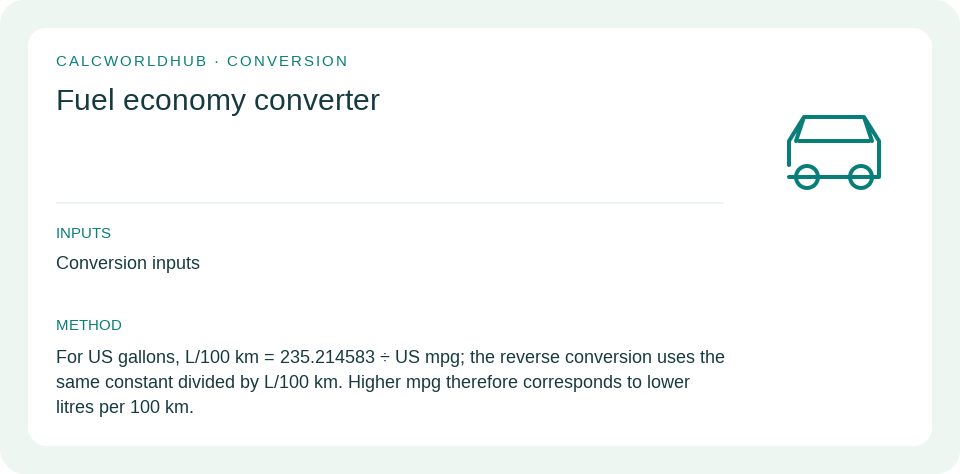
For US gallons, L/100 km = 235.214583 ÷ US mpg; the reverse conversion uses the same constant divided by L/100 km. Higher mpg therefore corresponds to lower litres per 100 km.
Worked example
At 30 US mpg, 235.214583 ÷ 30 = 7.8405 L/100 km, shown as about 7.84. The displayed result uses the selected direction.
Interpreting the result
The two scales run in opposite directions. A lower L/100 km value represents fewer litres used to cover 100 kilometres.
Assumptions and limits
This converter uses US gallons. Imperial-gallon mpg has a different conversion factor. Real road use also changes with speed, load, weather, driving style, and vehicle condition.
Sources and method notes
Read our calculation methodology.
Frequently asked questions
How do I use the Fuel economy converter?
Complete the labeled inputs for Fuel economy converter. Use the units requested by each field, then read the displayed result alongside the method and limits below.
What is a worked example of Fuel economy converter?
At 30 US mpg, 235.214583 ÷ 30 = 7.8405 L/100 km, shown as about 7.84. The displayed result uses the selected direction.
What does the Fuel economy converter calculate?
Convert between US miles per gallon and litres per 100 kilometres using the reciprocal fuel-economy relationship.
What assumptions apply to Fuel economy converter?
This converter uses US gallons. Imperial-gallon mpg has a different conversion factor. Real road use also changes with speed, load, weather, driving style, and vehicle condition.
Which method does the Fuel economy converter use?
For US gallons, L/100 km = 235.214583 ÷ US mpg; the reverse conversion uses the same constant divided by L/100 km. Higher mpg therefore corresponds to lower litres per 100 km.
Good calculators show their work.
CalcWorldHub is built around clear inputs and visible assumptions. Results are estimates for planning; check official sources or your provider’s terms when exact figures matter.