How to use this calculator
Separate residual carrier rotation, random phase jitter and additive noise in an uncorrected constellation EVM budget.
- Enter Residual RMS phase error (degrees), Residual static phase offset (degrees), Additive-noise symbol SNR (dB). Match the units shown beside each field and review the result together with the assumptions below.
- Read the worked example below to check the expected input format and result.
- Compare another scenario by changing one input at a time. Use Reset to return to the starting values.
Gaussian phase error contribution to EVM explained
Use Residual RMS phase error (degrees) with Residual static phase offset (degrees) to reproduce the sample calculation, then review the stated limits before carrying the result into another scenario.
A numerical walkthrough
Residual RMS phase error (degrees) = 2; Residual static phase offset (degrees) = 1; Additive-noise symbol SNR (dB) = 30.
- Total RMS EVM: 5.022472 %
- Phase-only RMS EVM: 3.901952 %
- Noise-only RMS EVM: 3.162278 %
A receiver with 2-degree RMS random phase error, 1-degree static rotation and 30 dB symbol SNR has distinct phase and additive contributions.
The model behind the numbers
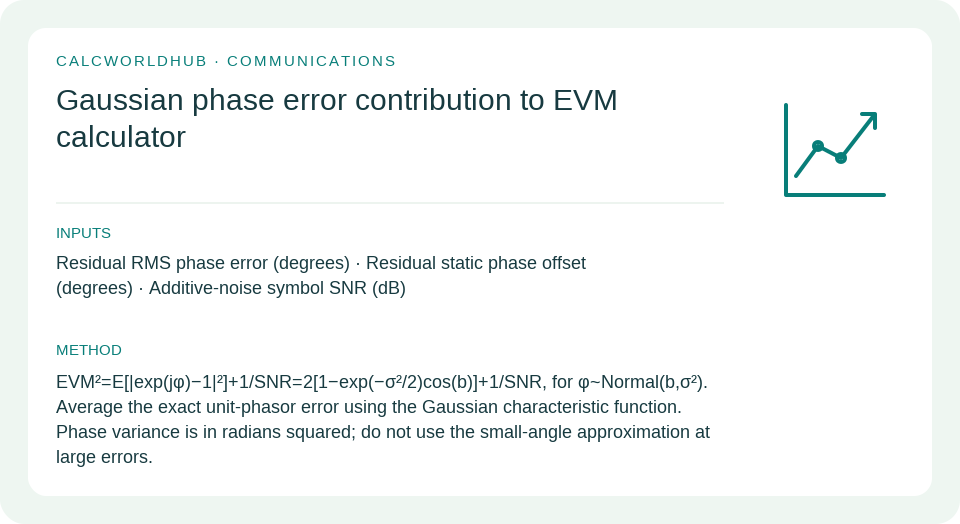
EVM²=E[|exp(jφ)−1|²]+1/SNR=2[1−exp(−σ²/2)cos(b)]+1/SNR, for φ~Normal(b,σ²).
Average the exact unit-phasor error using the Gaussian characteristic function. Phase variance is in radians squared; do not use the small-angle approximation at large errors.
What to enter
sigma— Residual RMS phase error (degrees)- Zero-mean Gaussian phase fluctuation after any carrier tracking.
bias— Residual static phase offset (degrees)- Constant uncompensated constellation rotation.
snr— Additive-noise symbol SNR (dB)- Average ideal symbol energy divided by complex additive error power.
Interpreting the result
Gaussian residual phase independent of zero-mean additive noise, no gain fitting or phase fitting in the EVM measurement. Instrument normalization conventions can differ.
Reading the outputs
All three metrics are RMS error normalized to ideal RMS constellation magnitude, expressed as percent. Total EVM combines independent error powers.
Frequently asked questions
Can carrier recovery remove the entered bias?
If your measurement fits a constant phase, set residual bias to zero after that correction.
Why not equate degrees directly to EVM percent?
The exact error depends on unit-circle chord length and radians; degree-to-percent conversion is not direct.
Does this predict coded BER?
No; modulation, receiver decisions and coding determine BER separately.
How do I use the Gaussian phase error contribution to EVM calculator?
Enter Residual RMS phase error (degrees), Residual static phase offset (degrees), Additive-noise symbol SNR (dB). Match the units shown beside each field and review the result together with the assumptions below.
What is a worked example of Gaussian phase error contribution to EVM?
Residual RMS phase error (degrees) = 2; Residual static phase offset (degrees) = 1; Additive-noise symbol SNR (dB) = 30. Total RMS EVM: 5.022472 % Phase-only RMS EVM: 3.901952 % Noise-only RMS EVM: 3.162278 % A receiver with 2-degree RMS random phase error, 1-degree static rotation and 30 dB symbol SNR has distinct phase and additive contributions.
Background or definition reference: Analog Devices error-vector magnitude measurement.
Read our calculation methodology.