How to use this calculator
Estimate horizontal, vertical, and combined GNSS position error from dilution factors and a stated range-error standard deviation.
- Enter Horizontal DOP (HDOP), Vertical DOP (VDOP), UERE standard deviation (m). Match the units shown beside each field and review the result together with the assumptions below.
- Read the worked example below to check the expected input format and result.
- Compare another scenario by changing one input at a time. Use Reset to return to the starting values.
How this calculation works
Enter the receiver's horizontal and vertical dilution of precision and a one-sigma user-equivalent range error in metres. The calculator maps this range-error model into horizontal and vertical RMS position estimates and combines those components by root-sum-square.
Inputs and units
hdop— Horizontal DOP (HDOP)- Dimensionless horizontal geometry factor from the receiver.
vdop— Vertical DOP (VDOP)- Dimensionless vertical geometry factor from the receiver.
uereM— UERE standard deviation (m)- One-sigma user-equivalent range error for the application, in metres.
Formula
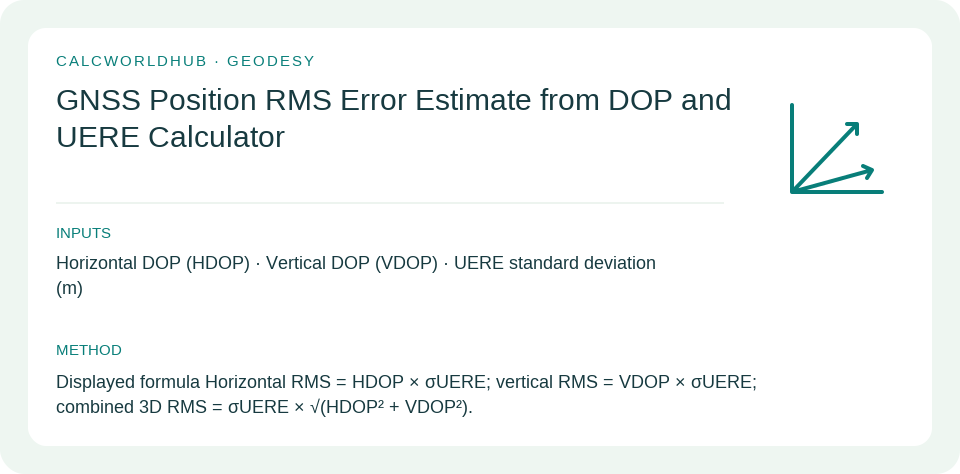
Horizontal RMS = HDOP × σUERE; vertical RMS = VDOP × σUERE; combined 3D RMS = σUERE × √(HDOP² + VDOP²).
Method
Multiply each entered DOP factor by the entered UERE standard deviation. The combined 3D estimate is the root-sum-square of the horizontal and vertical RMS components.
Worked example
With HDOP 1.2, VDOP 1.6, and a 4 m UERE standard deviation, the horizontal RMS estimate is 4.8 m, vertical is 6.4 m, and combined 3D RMS is 8.0 m.
Assumptions and limits
This is a conditional first-order RMS estimate, not a receiver accuracy guarantee. UERE must represent the error budget for the application; multipath, obstruction, correction services, receiver design, and the chosen confidence radius can change actual accuracy.
Frequently asked questions
What does UERE represent?
It is a one-sigma range-error model that combines relevant line-of-sight ranging error sources for the selected application.
Does a 4 m RMS result mean 95% accuracy within 4 m?
No. RMS and confidence-radius statements are different; this calculator reports RMS estimates only.
Can I use this as a guaranteed GPS accuracy?
No. It maps supplied DOP and UERE assumptions into an estimate and does not model every receiver, environment, or correction source.
How do I use the GNSS Position RMS Error Estimate from DOP and UERE Calculator?
Enter Horizontal DOP (HDOP), Vertical DOP (VDOP), UERE standard deviation (m). Match the units shown beside each field and review the result together with the assumptions below.
What is a worked example of GNSS Position RMS Error Estimate from DOP and UERE?
With HDOP 1.2, VDOP 1.6, and a 4 m UERE standard deviation, the horizontal RMS estimate is 4.8 m, vertical is 6.4 m, and combined 3D RMS is 8.0 m.
Reference: technical reference. See our calculation methodology.