Graham law effusion rate ratio calculator
Compare effusion rates of two gases from their molar masses. Enter your values below to see the result and method.
inputs.
Related calculators
These tools cover nearby questions while keeping this page focused on its own calculation.
How to use this calculator
Free Graham law effusion rate ratio calculator. Compare effusion rates of two gases from their molar masses. Formula, example, and assumptions explained.
- Enter Molar mass of gas 1 (g/mol), Molar mass of gas 2 (g/mol). Match the units shown beside each field and review the result together with the assumptions below.
- Read the worked example below to check the expected input format and result.
- Compare another scenario by changing one input at a time. Use Reset to return to the starting values.
Set the chemical conditions and units
Compare two idealized effusion rates at the same temperature and pressure. The lighter gas has the larger rate because the ratio varies with the inverse square root of molar mass.
Inputs and units
Enter positive molar masses for gases 1 and 2 in the same units; the rate ratio is gas 1 divided by gas 2.
- Molar mass of gas 1 (g/mol): Molar mass of the first gas in the comparison.
- Molar mass of gas 2 (g/mol): Molar mass of the second gas; both gases are compared at the same temperature and pressure.
Equation and worked example
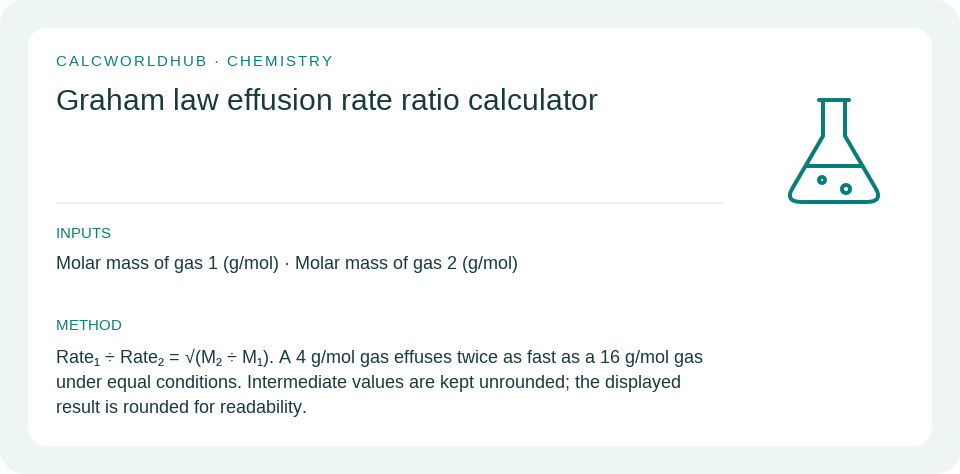
Rate₁ ÷ Rate₂ = √(M₂ ÷ M₁).
A 4 g/mol gas effuses twice as fast as a 16 g/mol gas under equal conditions.
Intermediate values are kept unrounded; the displayed result is rounded for readability.
Using the result
A ratio above one means gas 1 effuses faster; a ratio below one means gas 2 does. The comparison assumes the same temperature and effusion opening.
Assumptions and limitations
Ideal comparison for gases at the same temperature and through the same opening; lower molar mass gives the faster rate.
Frequently asked questions
What conditions are assumed for the two-gas comparison?
Enter both positive molar masses in g/mol; compare gas 1 with gas 2 at the same temperature and pressure.
When is Graham's law a useful approximation?
It compares relative effusion rates for gases under the same conditions; molecular-flow behavior and equal conditions are assumed, so real apparatus effects can change measured rates.
How do I use the Graham law effusion rate ratio calculator?
Enter Molar mass of gas 1 (g/mol), Molar mass of gas 2 (g/mol). Match the units shown beside each field and review the result together with the assumptions below.
What is a worked example of Graham law effusion rate ratio?
Rate₁ ÷ Rate₂ = √(M₂ ÷ M₁). A 4 g/mol gas effuses twice as fast as a 16 g/mol gas under equal conditions. Intermediate values are kept unrounded; the displayed result is rounded for readability.
What does the Graham law effusion rate ratio calculator calculate?
Free Graham law effusion rate ratio calculator. Compare effusion rates of two gases from their molar masses. Formula, example, and assumptions explained.
Read the calculation methodology and privacy policy.
Source: OpenStax Chemistry, Effusion and Diffusion of Gases.