How to use this calculator
Find the shortest surface arc between two latitude–longitude locations on an entered spherical radius.
- Enter Start latitude (degrees), Start longitude (degrees), End latitude (degrees), End longitude (degrees), then complete the remaining labeled fields. Match the units shown beside each field and review the result together with the assumptions below.
- Read the worked example below to check the expected input format and result.
- Compare another scenario by changing one input at a time. Use Reset to return to the starting values.
Great circle distance explained
The haversine equation gives the shortest surface arc between two latitude–longitude points on the entered sphere. It wraps longitude differences across the date line, but it does not follow roads or account for ellipsoidal geodesy or altitude.
How the calculation works
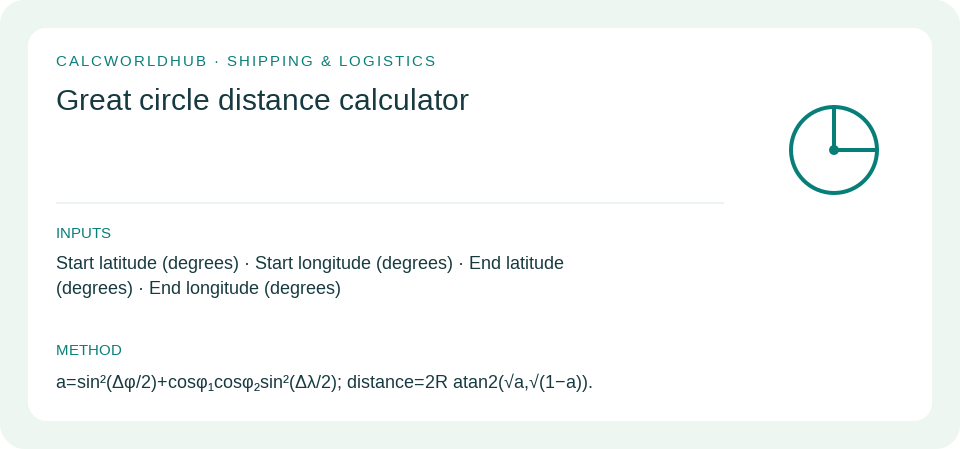
a=sin²(Δφ/2)+cosφ₁cosφ₂sin²(Δλ/2); distance=2R atan2(√a,√(1−a)).
Inputs and units
- Start latitude (degrees)
- Signed latitude from −90 to 90.
- Start longitude (degrees)
- Signed longitude from −180 to 180.
- End latitude (degrees)
- Destination latitude.
- End longitude (degrees)
- Destination longitude.
- Sphere radius (km)
- Radius of the spherical approximation.
Limits of this model
This uses a sphere, not an ellipsoid, and returns surface distance without altitude. It is a geographic approximation.
A road-route time planner uses a known traveled distance. Great-circle distance ignores roads and route restrictions.
Check a numerical scenario
Start latitude (degrees) = 0; Start longitude (degrees) = 0; End latitude (degrees) = 0; End longitude (degrees) = 1; Sphere radius (km) = 6371.
- Spherical surface distance: 111.1949 km
The inputs above are an illustrative scenario. Display values are rounded after the calculation.
Frequently asked questions
Is this driving distance?
No. Roads and detours are not represented.
Does it cross the date line correctly?
Yes. The trigonometric longitude difference handles wraparound.
Can I use another planet?
Yes, with that body’s chosen spherical radius.
How do I use the Great circle distance calculator?
Enter Start latitude (degrees), Start longitude (degrees), End latitude (degrees), End longitude (degrees), then complete the remaining labeled fields. Match the units shown beside each field and review the result together with the assumptions below.
What is a worked example of Great circle distance?
Start latitude (degrees) = 0; Start longitude (degrees) = 0; End latitude (degrees) = 0; End longitude (degrees) = 1; Sphere radius (km) = 6371. Spherical surface distance: 111.1949 km The inputs above are an illustrative scenario. Display values are rounded after the calculation.
See our calculation methodology.