How to use this calculator
Measure the share of opening recurring revenue retained after downgrades and customer churn, before upsells.
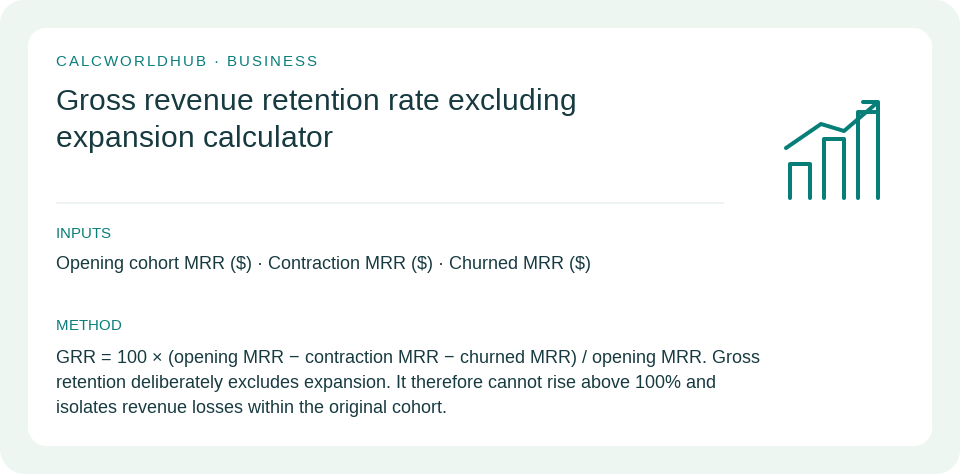
- Enter Opening cohort MRR ($), Contraction MRR ($), Churned MRR ($). Match the units shown beside each field and review the result together with the assumptions below.
- Read the worked example below to check the expected input format and result.
- Compare another scenario by changing one input at a time. Use Reset to return to the starting values.
Gross revenue retention rate excluding expansion explained
Enter opening MRR, contraction, and churn for one cohort and one period; GRR reports the share of starting recurring revenue left before expansion.
A numerical walkthrough
Opening cohort MRR ($) = 100000; Contraction MRR ($) = 3500; Churned MRR ($) = 5000.
- Gross revenue retention: 91.5 %
- Gross retained MRR: 91500 $ / month
- Revenue lost: 8500 $ / month
From $100,000 opening MRR, $3,500 contraction and $5,000 churn leave $91,500, or 91.5% GRR.
The model behind the numbers
GRR = 100 × (opening MRR − contraction MRR − churned MRR) / opening MRR.
Gross retention deliberately excludes expansion. It therefore cannot rise above 100% and isolates revenue losses within the original cohort.
What to enter
start— Opening cohort MRR ($)- Recurring monthly revenue from the period-start cohort.
contraction— Contraction MRR ($)- Downgrade losses in the cohort, entered as positive.
churn— Churned MRR ($)- Lost recurring revenue from canceled accounts, positive.
Interpreting the result
Revenue definitions and cohort period must match the accounting system. Do not include new customers or upsells in the numerator.
Reading the outputs
The percentage is the opening cohort MRR retained after contraction and churn; the dollar output is the corresponding monthly revenue still retained.
Frequently asked questions
Which revenue changes reduce gross revenue retention?
Contraction and churn reduce retained opening MRR. Expansion and new-customer revenue are excluded from gross revenue retention.
Does gross revenue retention include expansion?
No. GRR deliberately excludes expansion, so it cannot rise above 100% when opening MRR is positive and losses are nonnegative.
Why must the cohort period match across the inputs?
Opening MRR, contraction, and churn must cover the same opening customer cohort and time window; new customers and upsells do not belong in the numerator.
How do I use the Gross revenue retention rate excluding expansion calculator?
Enter Opening cohort MRR ($), Contraction MRR ($), Churned MRR ($). Match the units shown beside each field and review the result together with the assumptions below.
What is a worked example of Gross revenue retention rate excluding expansion?
Opening cohort MRR ($) = 100000; Contraction MRR ($) = 3500; Churned MRR ($) = 5000. Gross revenue retention: 91.5 % Gross retained MRR: 91500 $ / month Revenue lost: 8500 $ / month From $100,000 opening MRR, $3,500 contraction and $5,000 churn leave $91,500, or 91.5% GRR.
Read our calculation methodology.