How to use this calculator
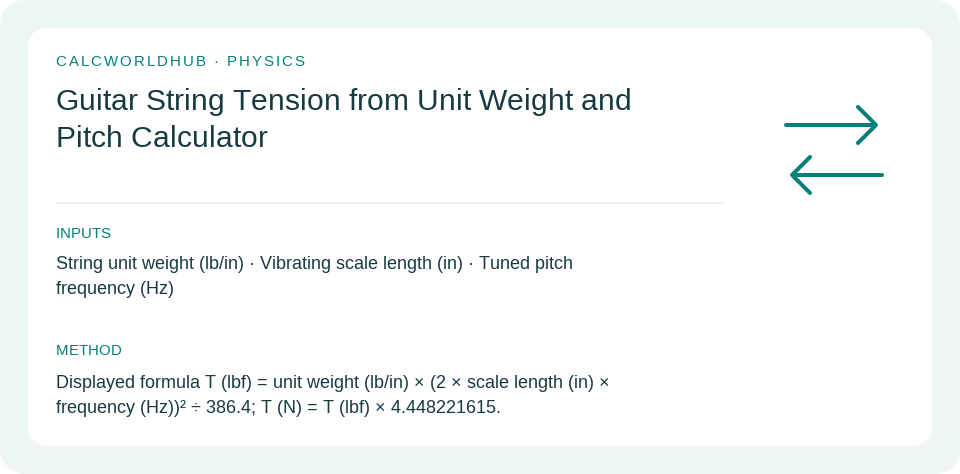
Estimate one guitar or bass string’s tension from its published unit weight, vibrating scale length, and tuned frequency.
- Enter String unit weight (lb/in), Vibrating scale length (in), Tuned pitch frequency (Hz). Match the units shown beside each field and review the result together with the assumptions below.
- Read the worked example below to check the expected input format and result.
- Compare another scenario by changing one input at a time. Use Reset to return to the starting values.
How this calculation works
Enter the string maker’s unit weight, the vibrating scale length from nut to bridge, and the target pitch frequency. The result helps compare how a different tuning or scale length changes the pull of one string.
Inputs and units
unitWeightLbPerIn— String unit weight (lb/in)- Use the string manufacturer’s unit weight for the exact gauge and construction. The default is only an example.
scaleLengthIn— Vibrating scale length (in)- Measure from the nut’s front edge to the bridge witness point.
frequencyHz— Tuned pitch frequency (Hz)- Enter the fundamental frequency of the open string or target pitch.
Formula
T (lbf) = unit weight (lb/in) × (2 × scale length (in) × frequency (Hz))² ÷ 386.4; T (N) = T (lbf) × 4.448221615.
Method
Use the manufacturer’s linear unit weight for the exact string construction. Multiply it by the square of twice the scale length and pitch frequency, then divide by standard gravitational acceleration expressed in inches per second squared. Convert the resulting pound-force value to newtons.
Worked example
For a unit weight of 0.0000222 lb/in, a 25.5 in scale, and a 329.63 Hz pitch, the estimated tension is about 16.24 lbf (72.23 N).
Assumptions and limits
This ideal vibrating-string estimate assumes a flexible string with a uniform published unit weight. Real tension can differ slightly because of string construction, stiffness, winding, and measurement conventions. Use the unit weight published for the exact string; the example default is illustrative.
Frequently asked questions
Where do I find string unit weight?
Use the string manufacturer’s published unit-weight or tension chart for the exact string construction and gauge.
Does this calculate a full guitar string set?
No. It estimates one string at a time. Repeat it for each string using that string’s unit weight and tuned frequency.
Why does scale length affect tension?
At the same string unit weight and pitch, a longer vibrating length requires more tension; the formula varies with the square of scale length.
How do I use the Guitar String Tension from Unit Weight and Pitch Calculator?
Enter String unit weight (lb/in), Vibrating scale length (in), Tuned pitch frequency (Hz). Match the units shown beside each field and review the result together with the assumptions below.
What is a worked example of Guitar String Tension from Unit Weight and Pitch?
For a unit weight of 0.0000222 lb/in, a 25.5 in scale, and a 329.63 Hz pitch, the estimated tension is about 16.24 lbf (72.23 N).
Reference: technical reference. See our calculation methodology.