How to use this calculator
Estimate rectangular habitat interior area after a uniform inward edge buffer removes edge habitat.
- Enter Rectangular patch length (m), Rectangular patch width (m), Uniform inward edge buffer (m). Match the units shown beside each field and review the result together with the assumptions below.
- Read the worked example below to check the expected input format and result.
- Compare another scenario by changing one input at a time. Use Reset to return to the starting values.
How this calculation works
The rectangular estimate subtracts the edge depth from both sides of each dimension. It is useful for a simple mapped rectangle and a uniform buffer assumption; irregular patches need a spatial GIS buffer to represent their true shape.
Inputs and units
patchLengthM— Rectangular patch length (m)- Length of the rectangular patch.
patchWidthM— Rectangular patch width (m)- Width of the rectangular patch.
edgeBufferM— Uniform inward edge buffer (m)- Distance removed from each of the four sides.
Formula
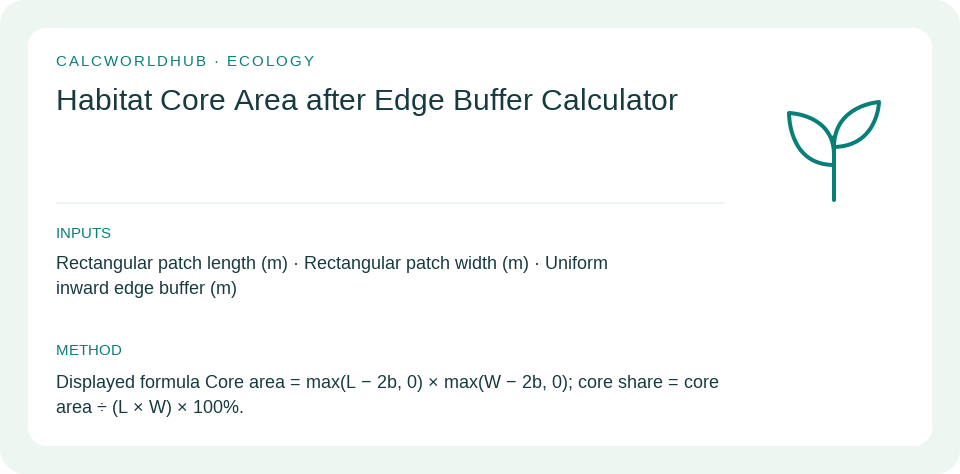
Core area = max(L − 2b, 0) × max(W − 2b, 0); core share = core area ÷ (L × W) × 100%.
Method
Use the same length unit for rectangle dimensions and edge-buffer depth. The model assumes a rectangle and a constant inward buffer from all four sides.
Worked example
For a 500 m by 300 m rectangle with a 25 m buffer, the estimated core is 112,500 m², or 75.00% of patch area.
Assumptions and limits
This simplified geometry does not model irregular boundaries, holes, corridors, or spatially varying edge-effect distances.
Frequently asked questions
How is the edge buffer applied?
The same inward distance is subtracted from both ends of each rectangle dimension.
What if the buffer is wider than the patch?
The estimated core area becomes zero when either remaining dimension is zero.
Does this work for irregular habitat shapes?
Use a GIS polygon buffer for irregular boundaries, holes, or corridors; this calculator is rectangular only.
How do I use the Habitat Core Area after Edge Buffer Calculator?
Enter Rectangular patch length (m), Rectangular patch width (m), Uniform inward edge buffer (m). Match the units shown beside each field and review the result together with the assumptions below.
What is a worked example of Habitat Core Area after Edge Buffer?
For a 500 m by 300 m rectangle with a 25 m buffer, the estimated core is 112,500 m², or 75.00% of patch area.
Reference: Conservation biology review defining core habitat beyond an edge-influence buffer. See our calculation methodology.