Hamming code data capacity calculator
Calculate how many data bits fit with a chosen number of classic Hamming parity bits. Enter your values below to see the result and method.
inputs.
Related calculators
These tools cover nearby questions while keeping this page focused on its own calculation.
How to use this calculator
Calculate how many data bits fit with a chosen number of classic Hamming parity bits.
- Enter Hamming parity bits r. Match the units shown beside each field and review the result together with the assumptions below.
- Read the worked example below to check the expected input format and result.
- Compare another scenario by changing one input at a time. Use Reset to return to the starting values.
Define the system or input
Calculate how many data bits fit with a chosen number of classic Hamming parity bits.
Inputs and units
Use the units printed beside each field. This value is Hamming parity bits r.
- Hamming parity bits r: Hamming parity bits r as defined for the physical or engineering situation.
Calculation method and example
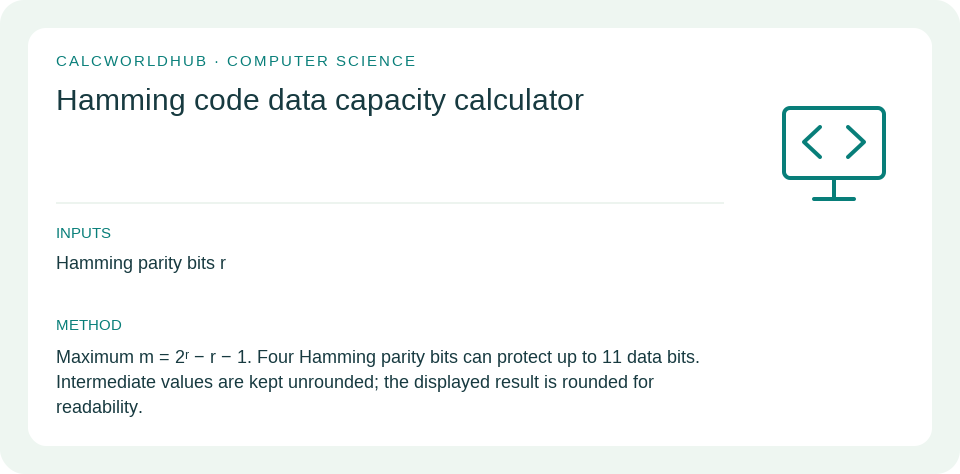
Maximum m = 2ʳ − r − 1.
Four Hamming parity bits can protect up to 11 data bits.
Intermediate values are kept unrounded; the displayed result is rounded for readability.
Interpreting the output
This is the maximum data-bit count for the classic single-error-correcting Hamming construction at the entered parity count; it excludes an extra overall SECDED parity bit.
Assumptions and limitations
Uses the classic single-error-correcting Hamming bound and excludes an optional overall parity bit.
Frequently asked questions
What does r represent in the data-capacity formula?
r is the number of Hamming parity bits. For the classic single-error-correcting code, the maximum data-bit count is m = 2ʳ − r − 1; an extra overall parity bit for SECDED is not included.
Does r include the extra SECDED parity bit?
No. r counts the classic Hamming parity positions; SECDED adds one separate overall parity bit.
When should I use Hamming code parity bits calculator?
Use this page when r is fixed and you need its maximum data-bit capacity. Use the parity-bit calculator when the data-bit count is fixed and r is unknown.
How do I use the Hamming code data capacity calculator?
Enter Hamming parity bits r. Match the units shown beside each field and review the result together with the assumptions below.
What is a worked example of Hamming code data capacity?
Maximum m = 2ʳ − r − 1. Four Hamming parity bits can protect up to 11 data bits. Intermediate values are kept unrounded; the displayed result is rounded for readability.
Read the calculation methodology and privacy policy.