How to use this calculator
Compare wick liquid-return capacity with a vapor choking estimate for a supplied heat-pipe geometry and operating state.
- Enter Liquid surface tension (N/m), Wick contact angle (degrees), Effective wick pore radius (m), Liquid density for hydrostatic head (kg/m³), then complete the remaining labeled fields. Match the units shown beside each field and review the result together with the assumptions below.
- Read the worked example below to check the expected input format and result.
- Compare another scenario by changing one input at a time. Use Reset to return to the starting values.
Heat pipe capillary and sonic transport limits explained
Use Liquid surface tension (N/m) with Wick contact angle (degrees) to reproduce the sample calculation, then review the stated limits before carrying the result into another scenario.
A numerical walkthrough
Liquid surface tension (N/m) = 0.06; Wick contact angle (degrees) = 20; Effective wick pore radius (m) = 0.00001; Liquid density for hydrostatic head (kg/m³) = 950; Evaporator elevation above condenser (m) = 0.1; Liquid dynamic viscosity (Pa s) = 0.0003; Effective liquid flow length (m) = 0.3; Liquid density times latent heat (J/m³) = 2100000000; Wick permeability (m²) = 1.00000000e-10; Liquid return wick flow area (m²) = 0.00001; Vapor flow area (m²) = 0.00002; Saturated vapor density (kg/m³) = 0.6; Latent heat for sonic transport (J/kg) = 2257000; Vapor specific gas constant (J/kg/K) = 461.5; Vapor stagnation temperature (K) = 373; Vapor heat-capacity ratio = 1.33.
- Liquid-return capillary heat limit: 241.37586 W
- Approximate vapor sonic heat limit: 6003.243176 W
- Lower of the two modeled limits: 241.37586 W
- Capillary pressure available after elevation: 10344.679699 Pa
The specified water-like wick and vapor geometry with a 0.1 m adverse lift retains 10,344.7 Pa capillary head. It supports a modeled liquid-return limit of 241.376 W, below the vapor sonic estimate, so liquid return governs this two-limit comparison.
The model behind the numbers
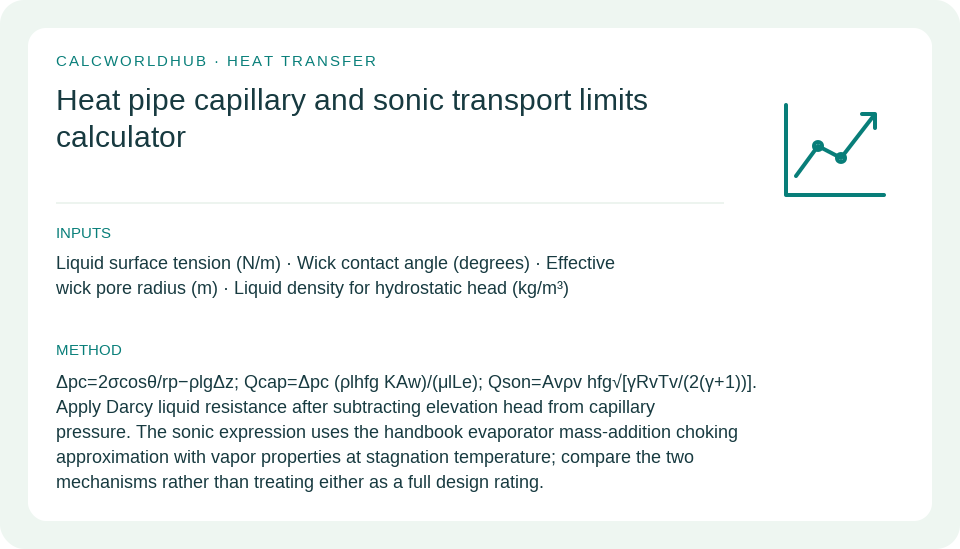
Δpc=2σcosθ/rp−ρlgΔz; Qcap=Δpc (ρlhfg KAw)/(μlLe); Qson=Avρv hfg√[γRvTv/(2(γ+1))].
Apply Darcy liquid resistance after subtracting elevation head from capillary pressure. The sonic expression uses the handbook evaporator mass-addition choking approximation with vapor properties at stagnation temperature; compare the two mechanisms rather than treating either as a full design rating.
What to enter
sig— Liquid surface tension (N/m)- Liquid surface tension (N/m). Enter the value for this state; the units shown are used without an unstated conversion.
ang— Wick contact angle (degrees)- Wick contact angle (degrees). Enter the value for this state; the units shown are used without an unstated conversion.
rp— Effective wick pore radius (m)- Effective wick pore radius (m). Enter the value for this state; the units shown are used without an unstated conversion.
rl— Liquid density for hydrostatic head (kg/m³)- Liquid density for hydrostatic head (kg/m³). Enter the value for this state; the units shown are used without an unstated conversion.
rise— Evaporator elevation above condenser (m)- Evaporator elevation above condenser (m). Enter the value for this state; the units shown are used without an unstated conversion.
mu— Liquid dynamic viscosity (Pa s)- Liquid dynamic viscosity (Pa s). Enter the value for this state; the units shown are used without an unstated conversion.
Le— Effective liquid flow length (m)- Effective liquid flow length (m). Enter the value for this state; the units shown are used without an unstated conversion.
rhoh— Liquid density times latent heat (J/m³)- Liquid density times latent heat (J/m³). Enter the value for this state; the units shown are used without an unstated conversion.
perm— Wick permeability (m²)- Wick permeability (m²). Enter the value for this state; the units shown are used without an unstated conversion.
Aw— Liquid return wick flow area (m²)- Liquid return wick flow area (m²). Enter the value for this state; the units shown are used without an unstated conversion.
Av— Vapor flow area (m²)- Vapor flow area (m²). Enter the value for this state; the units shown are used without an unstated conversion.
rv— Saturated vapor density (kg/m³)- Saturated vapor density (kg/m³). Enter the value for this state; the units shown are used without an unstated conversion.
latent— Latent heat for sonic transport (J/kg)- Latent heat for sonic transport (J/kg). Enter the value for this state; the units shown are used without an unstated conversion.
Rspec— Vapor specific gas constant (J/kg/K)- Vapor specific gas constant (J/kg/K). Enter the value for this state; the units shown are used without an unstated conversion.
T— Vapor stagnation temperature (K)- Vapor stagnation temperature (K). Enter the value for this state; the units shown are used without an unstated conversion.
gamma— Vapor heat-capacity ratio- Vapor heat-capacity ratio. Enter the value for this state; the units shown are used without an unstated conversion.
Interpreting the result
Screening model neglects vapor pressure loss in the capillary balance, entrainment, boiling, viscous/startup limits, wick dryout geometry and temperature dependence. The minimum is not a certified safe operating load.
Reading the outputs
Both heat limits and their minimum are W; remaining capillary pressure is Pa. The liquid volumetric latent content input is rho_l times latent heat.
Frequently asked questions
Does a larger pore radius always improve transport?
It lowers capillary pressure, while permeability may increase; both must be changed consistently from wick data.
Can the condenser be above the evaporator?
Yes. A negative evaporator rise gives gravity-assisted liquid return.
Are these the only heat-pipe failure limits?
No. Entrainment, boiling, viscous and startup limits can be more restrictive.
How do I use the Heat pipe capillary and sonic transport limits calculator?
Enter Liquid surface tension (N/m), Wick contact angle (degrees), Effective wick pore radius (m), Liquid density for hydrostatic head (kg/m³), then complete the remaining labeled fields. Match the units shown beside each field and review the result together with the assumptions below.
What is a worked example of Heat pipe capillary and sonic transport limits?
Liquid surface tension (N/m) = 0.06; Wick contact angle (degrees) = 20; Effective wick pore radius (m) = 0.00001; Liquid density for hydrostatic head (kg/m³) = 950; Evaporator elevation above condenser (m) = 0.1; Liquid dynamic viscosity (Pa s) = 0.0003; Effective liquid flow length (m) = 0.3; Liquid density times latent heat (J/m³) = 2100000000; Wick permeability (m²) = 1.00000000e-10; Liquid return wick flow area (m²) = 0.00001; Vapor flow area (m²) = 0.00002; Saturated vapor density (kg/m³) = 0.6; Latent heat for sonic transport (J/kg) = 2257000; Vapor specific gas constant (J/kg/K) = 461.5; Vapor stagnation temperature (K) = 373; Vapor heat-capacity ratio = 1.33.
Background or definition reference: NASA Heat Pipe Design Handbook Volume I.
Read our calculation methodology.