How to use this calculator
Sum heating and cooling degree days from a series of daily mean temperatures and a user-selected base temperature.
- Enter Daily mean temperatures, Base temperature, Temperature scale. Match the units shown beside each field and review the result together with the assumptions below.
- Read the worked example below to check the expected input format and result.
- Compare another scenario by changing one input at a time. Use Reset to return to the starting values.
How this calculation works
Degree days turn daily mean temperature departures from a chosen balance point into a seasonal heating or cooling indicator. This calculator accepts daily means directly, accumulates heating departures below the base and cooling departures above it, and keeps the chosen temperature scale throughout.
Inputs and units
dailyMeans— Daily mean temperatures- Enter one mean temperature for each day, separated by commas, spaces, or new lines.
baseTemp— Base temperature- Heating/cooling balance point in the same temperature scale as the daily values.
temperatureUnit— Temperature scale- Choose the scale used for both daily means and the base value.
Formula
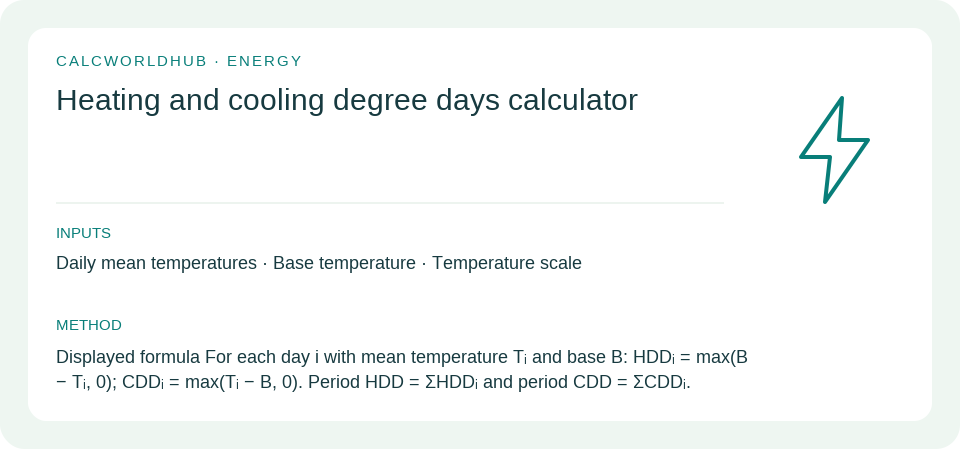
For each day i with mean temperature Tᵢ and base B: HDDᵢ = max(B − Tᵢ, 0); CDDᵢ = max(Tᵢ − B, 0). Period HDD = ΣHDDᵢ and period CDD = ΣCDDᵢ.
Method
Paste one daily mean temperature per line or separate values with commas or spaces. Enter the base temperature in the same scale and select °F or °C for the labels. The familiar U.S. 65°F base is common, but building balance temperatures and regional practices can differ.
Worked example
For daily means of 50°F, 55°F, and 60°F with a 65°F base, the daily heating values are 15, 10, and 5°F-days, totaling 30°F-days. No day exceeds the base, so cooling degree days total zero.
Assumptions and limits
This method uses daily means and a fixed base, so it is an index rather than a building energy model. It does not apply daily temperature range corrections, occupancy schedules, solar gains, humidity, equipment efficiency, or weather normalization. Use a consistent base and temperature series when comparing periods.
Frequently asked questions
What is a heating degree day?
For a daily mean below the base, it is the base temperature minus that mean; days above the base contribute zero heating degree days.
Why is 65°F often used as the base?
It is a conventional U.S. reporting base used by NOAA climate summaries, but a building’s balance point may differ.
Can I use Celsius temperatures?
Yes. Enter daily means and the base in °C, then select °C; do not mix Fahrenheit and Celsius values in one series.
How do I use the Heating and cooling degree days calculator?
Enter Daily mean temperatures, Base temperature, Temperature scale. Match the units shown beside each field and review the result together with the assumptions below.
What is a worked example of Heating and cooling degree days?
For daily means of 50°F, 55°F, and 60°F with a 65°F base, the daily heating values are 15, 10, and 5°F-days, totaling 30°F-days. No day exceeds the base, so cooling degree days total zero.
Reference: technical reference. See our calculation methodology.