How to use this calculator
Estimate single-measure absolute-agreement intraclass correlation for a complete two-way random-rater design.
- Enter Subject rows, rater columns, Raters per subject. Match the units shown beside each field and review the result together with the assumptions below.
- Read the worked example below to check the expected input format and result.
- Compare another scenario by changing one input at a time. Use Reset to return to the starting values.
ICC two way random absolute agreement explained
ICC(2,1) estimates single-rater absolute agreement when each subject is measured by the same set of randomly sampled raters. Unlike consistency ICC, systematic rater differences count as disagreement; the two-way random-effects assumptions determine how far the result generalizes.
Inputs, symbols, and units
x— Subject rows, rater columns- Subject rows, rater columns. Use comma-separated values in the stated order.
k— Raters per subject- Raters per subject. Enter a whole number.
Formula and method
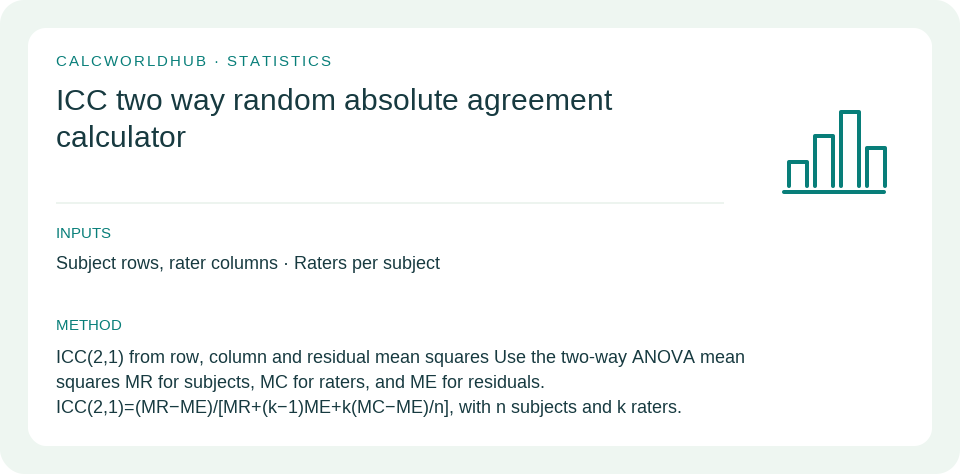
ICC(2,1) from row, column and residual mean squares
Use the two-way ANOVA mean squares MR for subjects, MC for raters, and ME for residuals. ICC(2,1)=(MR−ME)/[MR+(k−1)ME+k(MC−ME)/n], with n subjects and k raters.
A worked scenario
Subject rows, rater columns = 1, 2, 1, 3, 4, 3, 5, 5, 6, 7, 8, 7; Raters per subject = 3.
- ICC(2,1) absolute agreement: 0.95180723
Four subjects were each rated three times. The checked single-measure absolute-agreement ICC is 0.9518072289.
Assumptions and edge cases
Every subject must be measured by every rater; raters are treated as a random sample. This is ICC(2,1), not a consistency or average-measure ICC.
Frequently asked questions
Can negative ICC occur?
Yes, sampling variation can yield negative estimates.
What does single measure mean?
Reliability of one rater’s measurement, rather than the mean of several raters.
Can fixed raters use the same interpretation?
The intended random-rater generalization would not match.
How do I use the ICC two way random absolute agreement calculator?
Enter Subject rows, rater columns, Raters per subject. Match the units shown beside each field and review the result together with the assumptions below.
What is a worked example of ICC two way random absolute agreement?
Subject rows, rater columns = 1, 2, 1, 3, 4, 3, 5, 5, 6, 7, 8, 7; Raters per subject = 3. ICC(2,1) absolute agreement: 0.95180723 Four subjects were each rated three times. The checked single-measure absolute-agreement ICC is 0.9518072289.
Read our calculation methodology.