How to use this calculator
Compare the first-vapor and first-liquid equilibrium limits of an ideal binary liquid at a fixed temperature.
- Enter Specified component A mole fraction, Pure A saturation pressure at fixed temperature (kPa), Pure B saturation pressure at fixed temperature (kPa). Match the units shown beside each field and review the result together with the assumptions below.
- Read the worked example below to check the expected input format and result.
- Compare another scenario by changing one input at a time. Use Reset to return to the starting values.
Ideal binary mixture bubble and dew pressure explained
A numerical walkthrough
Specified component A mole fraction = 0.4; Pure A saturation pressure at fixed temperature (kPa) = 100; Pure B saturation pressure at fixed temperature (kPa) = 40.
- Bubble pressure for liquid z: 64 kPa
- Dew pressure for vapor z: 52.631579 kPa
- First vapor A mole fraction: 0.625
- First liquid A mole fraction: 0.210526
For an ideal binary mixture with overall A fraction 0.4 and pure vapor pressures 100 and 40 kPa, bubble pressure is 64 kPa and dew pressure is 52.6316 kPa. At those boundaries the incipient vapor A fraction is 0.625 and incipient liquid A fraction is 0.210526.
The model behind the numbers
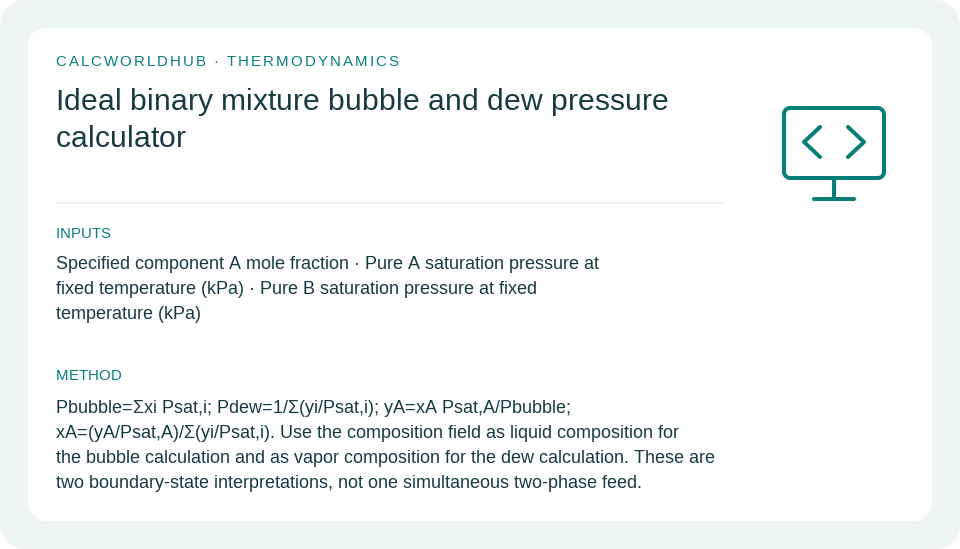
Pbubble=Σxi Psat,i; Pdew=1/Σ(yi/Psat,i); yA=xA Psat,A/Pbubble; xA=(yA/Psat,A)/Σ(yi/Psat,i).
Use the composition field as liquid composition for the bubble calculation and as vapor composition for the dew calculation. These are two boundary-state interpretations, not one simultaneous two-phase feed.
What to enter
z— Specified component A mole fraction- Specified component A mole fraction. Enter the value for this state; the units shown are used without an unstated conversion.
pa— Pure A saturation pressure at fixed temperature (kPa)- Pure A saturation pressure at fixed temperature (kPa). Enter the value for this state; the units shown are used without an unstated conversion.
pb— Pure B saturation pressure at fixed temperature (kPa)- Pure B saturation pressure at fixed temperature (kPa). Enter the value for this state; the units shown are used without an unstated conversion.
Interpreting the result
Ideal liquid and ideal vapor, common temperature, no activity coefficients or pressure correction. No azeotrope or nonideal flash split.
Reading the outputs
The two pressures are kPa; first-vapor and first-liquid compositions are molar fractions.
Frequently asked questions
Why are bubble and dew pressures different at the same z?
The composition describes different phases in the two calculations.
Can the pure-component endpoints be used?
Yes. Both boundaries collapse to that component’s saturation pressure.
Is this a flash vapor fraction?
No. It finds phase-boundary pressures, not the amount of each phase in a feed.
How do I use the Ideal binary mixture bubble and dew pressure calculator?
Enter Specified component A mole fraction, Pure A saturation pressure at fixed temperature (kPa), Pure B saturation pressure at fixed temperature (kPa). Match the units shown beside each field and review the result together with the assumptions below.
What is a worked example of Ideal binary mixture bubble and dew pressure?
Specified component A mole fraction = 0.4; Pure A saturation pressure at fixed temperature (kPa) = 100; Pure B saturation pressure at fixed temperature (kPa) = 40. Bubble pressure for liquid z: 64 kPa Dew pressure for vapor z: 52.631579 kPa First vapor A mole fraction: 0.625 First liquid A mole fraction: 0.210526 For an ideal binary mixture with overall A fraction 0.4 and pure vapor pressures 100 and 40 kPa, bubble pressure is 64 kPa and dew pressure is 52.6316 kPa. At those boundaries the incipient vapor A fraction is 0.625 and incipient liquid A fraction is 0.210526.
Read our calculation methodology.