How to use this calculator
Measure the entropy created when separated ideal gas species at the same pressure and temperature mix without doing useful work.
- Enter Amounts of distinct ideal gas species (mol), Mixing environment temperature (K). Match the units shown beside each field and review the result together with the assumptions below.
- Read the worked example below to check the expected input format and result.
- Compare another scenario by changing one input at a time. Use Reset to return to the starting values.
Ideal distinct-gas mixing entropy and lost work explained
Mixing initially separated, chemically distinct ideal gases creates entropy even when initial temperatures and pressures match. The entropy depends on mole fractions; multiplying it by ambient absolute temperature gives the reversible work potential destroyed by the mixing process.
Inputs, symbols, and units
n— Amounts of distinct ideal gas species (mol)- Enter one nonnegative mole amount per chemically distinct species; repeated amounts of the same gas must be combined first. Use comma-separated values in the stated order.
T0— Mixing environment temperature (K)- Positive ambient absolute temperature in kelvin; scales destroyed work but does not change the ideal mixing entropy.
Formula and method
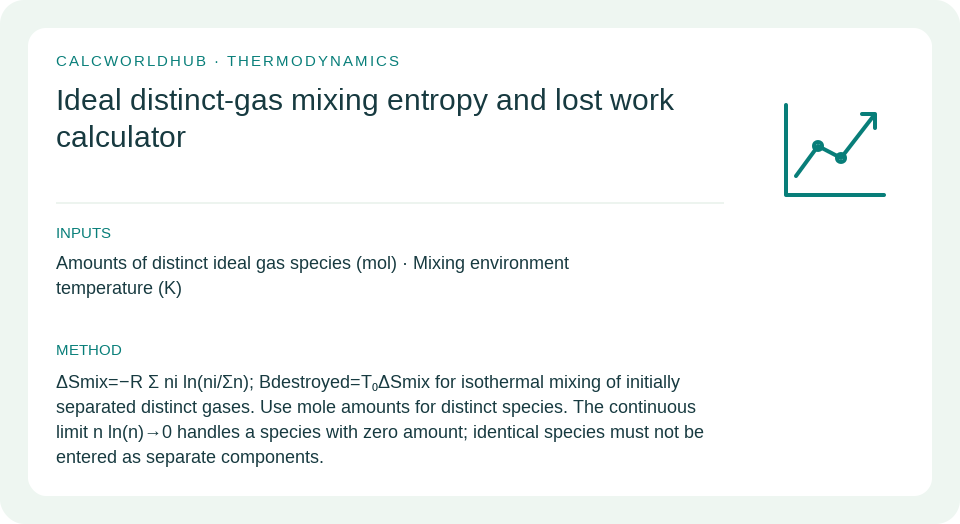
ΔSmix=−R Σ ni ln(ni/Σn); Bdestroyed=T₀ΔSmix for isothermal mixing of initially separated distinct gases.
Use mole amounts for distinct species. The continuous limit n ln(n)→0 handles a species with zero amount; identical species must not be entered as separate components.
A worked scenario
Amounts of distinct ideal gas species (mol) = [1, 2, 1]; Mixing environment temperature (K) = 298.15.
- Mixing entropy: 34.578878 J/K
- Lost reversible work at ambient: 10.309692 kJ
- Total amount: 4 mol
Mixing 1, 2 and 1 mol of three distinct ideal species produces 34.5789 J/K entropy at equal initial temperature and pressure. At 298.15 K, the corresponding destroyed work potential is 10.3097 kJ.
Assumptions and edge cases
Initially separated ideal species at equal temperature and pressure. Unequal temperatures or pressures create additional entropy not included here.
Reading the outputs
Entropy is in J/K, ambient lost work in kJ, and total amount in moles.
Frequently asked questions
Does mixing two samples of nitrogen create this entropy?
No. Identical gas is one species; combine its mole amounts first.
Can a zero component be included?
Yes. Its limiting entropy contribution is zero.
Is heat of mixing included?
Ideal gas mixing has no enthalpy of mixing at equal temperature; nonideal mixtures need a different model.
How do I use the Ideal distinct-gas mixing entropy and lost work calculator?
Enter Amounts of distinct ideal gas species (mol), Mixing environment temperature (K). Match the units shown beside each field and review the result together with the assumptions below.
What is a worked example of Ideal distinct-gas mixing entropy and lost work?
Amounts of distinct ideal gas species (mol) = [1, 2, 1]; Mixing environment temperature (K) = 298.15. Mixing entropy: 34.578878 J/K Lost reversible work at ambient: 10.309692 kJ Total amount: 4 mol Mixing 1, 2 and 1 mol of three distinct ideal species produces 34.5789 J/K entropy at equal initial temperature and pressure. At 298.15 K, the corresponding destroyed work potential is 10.3097 kJ.
Read our calculation methodology.