How to use this calculator
Evaluate entropy change for any two calorically perfect gas states, including compression with heating or expansion with cooling.
- Enter Initial gas temperature (K), Final gas temperature (K), Initial absolute pressure (kPa), Final absolute pressure (kPa), then complete the remaining labeled fields. Match the units shown beside each field and review the result together with the assumptions below.
- Read the worked example below to check the expected input format and result.
- Compare another scenario by changing one input at a time. Use Reset to return to the starting values.
Ideal gas entropy change between two states explained
A numerical walkthrough
Initial gas temperature (K) = 300; Final gas temperature (K) = 500; Initial absolute pressure (kPa) = 100; Final absolute pressure (kPa) = 400; Specific heat cp (kJ/kg/K) = 1.005; Specific gas constant (kJ/kg/K) = 0.287; Gas mass (kg) = 2.
- Specific entropy change: 0.115513 kJ/kg/K
- Total entropy change: 0.231027 kJ/K
- Specific enthalpy change: 201 kJ/kg
Heating 2 kg of ideal gas from 300 to 500 K while pressure rises from 100 to 400 kPa gives specific entropy change 0.115513 kJ/kg/K. Total entropy increases 0.231027 kJ/K even though compression offsets part of the thermal entropy increase.
The model behind the numbers
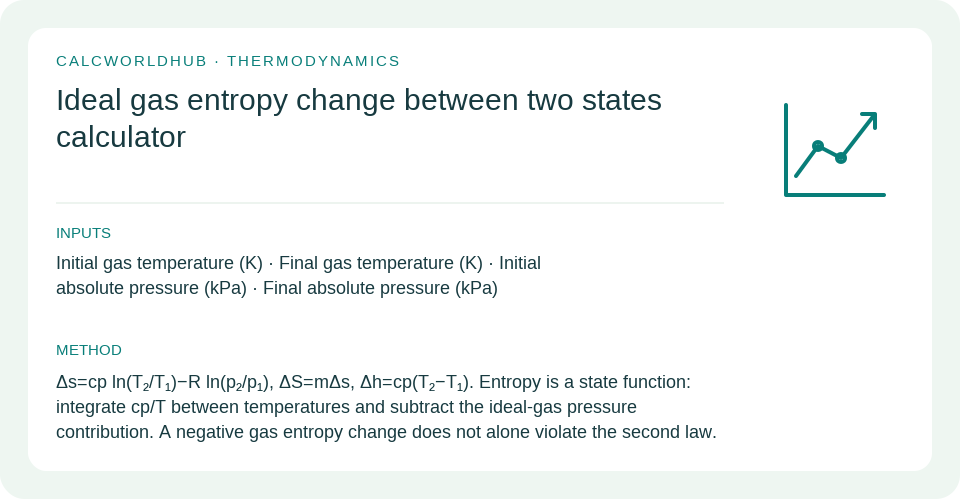
Δs=cp ln(T₂/T₁)−R ln(p₂/p₁), ΔS=mΔs, Δh=cp(T₂−T₁).
Entropy is a state function: integrate cp/T between temperatures and subtract the ideal-gas pressure contribution. A negative gas entropy change does not alone violate the second law.
What to enter
T1— Initial gas temperature (K)- Initial gas temperature (K). Enter the value for this state; the units shown are used without an unstated conversion.
T2— Final gas temperature (K)- Final gas temperature (K). Enter the value for this state; the units shown are used without an unstated conversion.
p1— Initial absolute pressure (kPa)- Initial absolute pressure (kPa). Enter the value for this state; the units shown are used without an unstated conversion.
p2— Final absolute pressure (kPa)- Final absolute pressure (kPa). Enter the value for this state; the units shown are used without an unstated conversion.
cp— Specific heat cp (kJ/kg/K)- Specific heat cp (kJ/kg/K). Enter the value for this state; the units shown are used without an unstated conversion.
R— Specific gas constant (kJ/kg/K)- Specific gas constant (kJ/kg/K). Enter the value for this state; the units shown are used without an unstated conversion.
m— Gas mass (kg)- Gas mass (kg). Enter the value for this state; the units shown are used without an unstated conversion.
Interpreting the result
Ideal gas with temperature-independent cp; this is gas entropy change, not entropy generation of the gas plus surroundings.
Reading the outputs
Specific and total entropy changes are signed. Enthalpy change uses the same constant cp assumption.
Frequently asked questions
Does negative entropy change mean an impossible process?
No. Heat rejection can lower the gas entropy while increasing total entropy of gas and surroundings.
Can gauge pressures be entered?
No. Logarithmic pressure ratios require absolute pressure.
Does Δs=0 prove the path was reversible?
It only shows equal endpoint entropy; path irreversibility needs a complete entropy balance.
How do I use the Ideal gas entropy change between two states calculator?
Enter Initial gas temperature (K), Final gas temperature (K), Initial absolute pressure (kPa), Final absolute pressure (kPa), then complete the remaining labeled fields. Match the units shown beside each field and review the result together with the assumptions below.
What is a worked example of Ideal gas entropy change between two states?
Initial gas temperature (K) = 300; Final gas temperature (K) = 500; Initial absolute pressure (kPa) = 100; Final absolute pressure (kPa) = 400; Specific heat cp (kJ/kg/K) = 1.005; Specific gas constant (kJ/kg/K) = 0.287; Gas mass (kg) = 2. Specific entropy change: 0.115513 kJ/kg/K Total entropy change: 0.231027 kJ/K Specific enthalpy change: 201 kJ/kg Heating 2 kg of ideal gas from 300 to 500 K while pressure rises from 100 to 400 kPa gives specific entropy change 0.115513 kJ/kg/K. Total entropy increases 0.231027 kJ/K even though compression offsets part of the thermal entropy increase.
Background or definition reference: NASA Glenn ideal gas compression and expansion.
Read our calculation methodology.