How to use this calculator
Inspect the binary32 rounding and hexadecimal bit pattern of a finite decimal input.
- Enter Decimal value. Match the units shown beside each field and review the result together with the assumptions below.
- Read the worked example below to check the expected input format and result.
- Compare another scenario by changing one input at a time. Use Reset to return to the starting values.
IEEE 754 binary32 representation explained
This guide follows ieee 754 binary32 representation calculator from its stated formula through a worked example, then identifies the assumptions that bound the result.
Example with entered values
Decimal value = 0.1.
- Stored binary32 decimal value: 0.10000000149
- Binary32 bit pattern: 0x3DCCCCCD
- Rounding error: 1.490116e-09
The inputs above are an illustrative scenario. Display values are rounded after the calculation.
The calculation behind the result
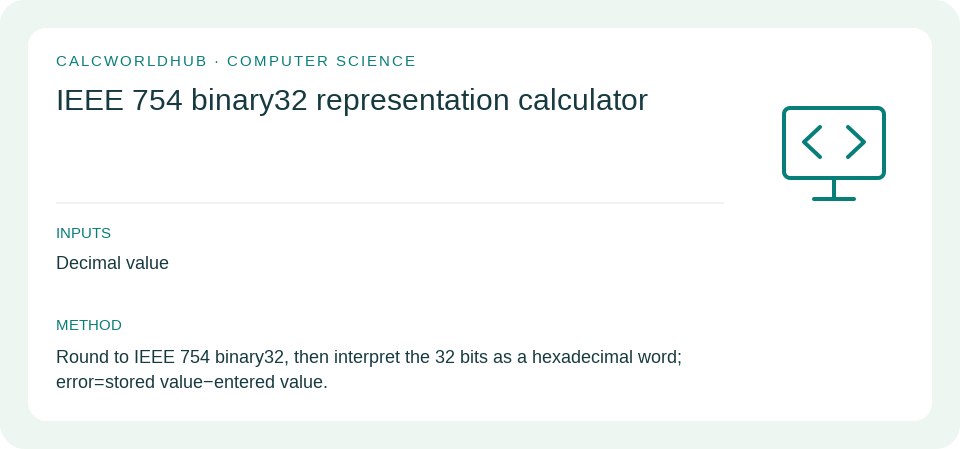
Round to IEEE 754 binary32, then interpret the 32 bits as a hexadecimal word; error=stored value−entered value.
Inputs and units
- Decimal value
- Finite numeric value to round to binary32.
Before interpreting the result
Input first passes through JavaScript binary64 parsing. Results outside finite binary32 range are rejected; extremely small values may underflow.
Two’s-complement tools encode integers. Binary32 uses a floating-point sign, exponent, and significand.
Frequently asked questions
Why is 0.1 not stored exactly?
A finite binary fraction cannot exactly represent decimal one tenth.
Is the hex result byte-order dependent?
It is displayed as a canonical big-endian 32-bit word.
Can this show NaN or infinity?
This finite-input version excludes those special values.
How do I use the IEEE 754 binary32 representation calculator?
Enter Decimal value. Match the units shown beside each field and review the result together with the assumptions below.
What is a worked example of IEEE 754 binary32 representation?
Decimal value = 0.1. Stored binary32 decimal value: 0.10000000149 Binary32 bit pattern: 0x3DCCCCCD Rounding error: 1.490116e-09 The inputs above are an illustrative scenario. Display values are rounded after the calculation.
Method reference: ECMAScript DataView structured-data specification (checked October 15, 2026).
See our calculation methodology.