Inbreeding coefficient from heterozygosity calculator
Compare observed and expected heterozygosity to estimate a population inbreeding coefficient. Enter your values below to see the result and method.
inputs.
Related calculators
How to use this calculator
Compare observed and expected heterozygosity to estimate a population inbreeding coefficient.
- Enter Expected heterozygosity Hₑ, Observed heterozygosity Hₒ. Match the units shown beside each field and review the result together with the assumptions below.
- Read the worked example below to check the expected input format and result.
- Compare another scenario by changing one input at a time. Use Reset to return to the starting values.
State the inheritance or population assumptions
Compare observed heterozygosity with a reference expectation to express heterozygote deficit or excess as F. Compare observed and expected heterozygosity to estimate a population inbreeding coefficient.
Inputs and units
- Expected heterozygosity Hₑ:Reference expected heterozygosity for the same locus and population model.
- Observed heterozygosity Hₒ:Observed fraction of heterozygotes from the matching sample and locus.
Genetics formula and example
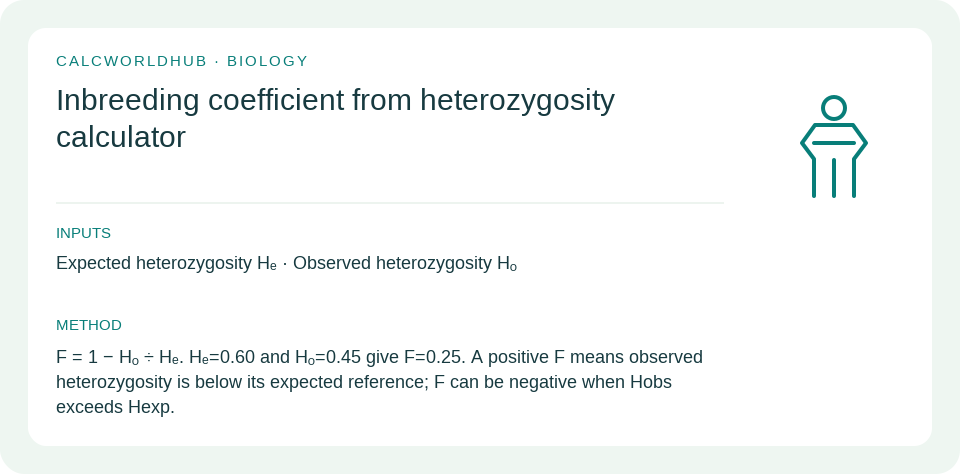
F = 1 − Hₒ ÷ Hₑ.
Hₑ=0.60 and Hₒ=0.45 give F=0.25.
A positive F means observed heterozygosity is below its expected reference; F can be negative when Hobs exceeds Hexp.
Interpreting the expectation
F compares observed heterozygosity with the selected reference expectation; sampling design and population structure affect interpretation.
Assumptions and limitations
Interpretation depends on population sampling and the reference expectation; negative estimates can occur when observed heterozygosity exceeds expected.
Source and method
The linked population-genetics material gives the allele-frequency basis for expected heterozygosity; F compares observed with expected heterozygosity. OpenStax Biology 2e — Population Evolution.
Frequently asked questions
What should I enter for the inbreeding coefficient from heterozygosity?
Enter Expected heterozygosity Hₑ, Observed heterozygosity Hₒ. Use the units shown beside each field and values from the same sample or model.
Which assumptions matter for this inbreeding coefficient from heterozygosity?
Interpretation depends on population sampling and the reference expectation; negative estimates can occur when observed heterozygosity exceeds expected.
How does this compare with expected heterozygosity from allele frequencies?
That tool estimates expected diversity from allele frequencies. This page compares an expected heterozygosity value with an observed one: F=1−Hₒ/Hₑ; negative estimates are possible when Hₒ>Hₑ.
How do I use the Inbreeding coefficient from heterozygosity calculator?
Enter Expected heterozygosity Hₑ, Observed heterozygosity Hₒ. Match the units shown beside each field and review the result together with the assumptions below.
What is a worked example of Inbreeding coefficient from heterozygosity?
F = 1 − Hₒ ÷ Hₑ. Hₑ=0.60 and Hₒ=0.45 give F=0.25. A positive F means observed heterozygosity is below its expected reference; F can be negative when Hobs exceeds Hexp.
Read the calculation methodology and privacy policy.