How to use this calculator
Compare treatment and control conversion value to estimate incremental return on ad spend.
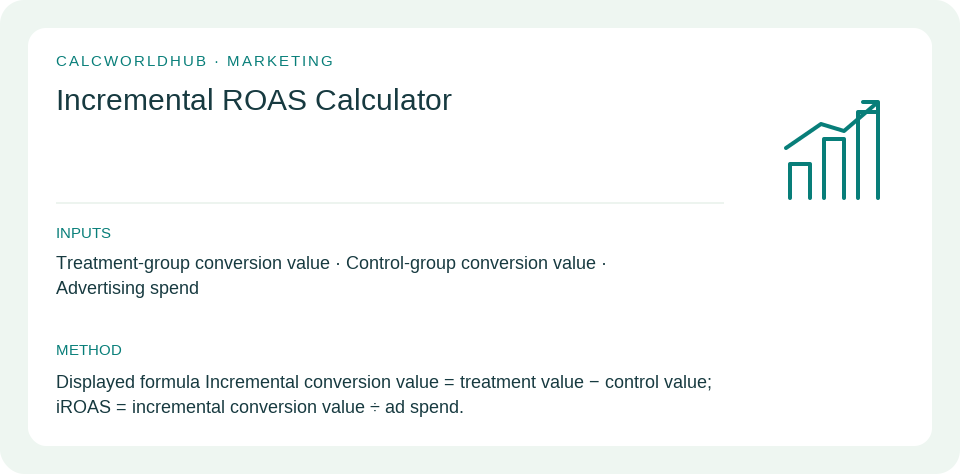
- Enter Treatment-group conversion value, Control-group conversion value, Advertising spend. Match the units shown beside each field and review the result together with the assumptions below.
- Read the worked example below to check the expected input format and result.
- Compare another scenario by changing one input at a time. Use Reset to return to the starting values.
How this calculation works
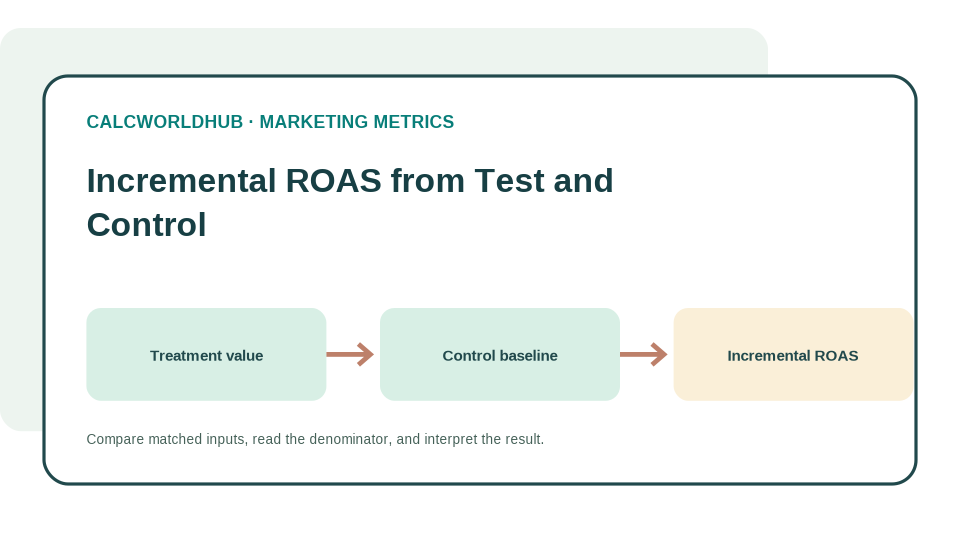
Incremental ROAS estimates the additional conversion value associated with an advertising lift study, rather than dividing all attributed revenue by spend. Use treatment and control values produced on the same basis by the study, then divide their difference by total ad spend.
Inputs and units
treatmentValue— Treatment-group conversion value- Conversion value reported for the campaign's treatment group, in your currency.
controlValue— Control-group conversion value- Control estimate scaled to the same eligible population or exposure basis as treatment, for the same study and period.
spend— Advertising spend- Total ad spend used for the iROAS calculation, in the same currency.
Formula
Incremental conversion value = treatment value − control value; iROAS = incremental conversion value ÷ ad spend.
Method
Treatment and control conversion values must first represent the same eligible-population or exposure scale. If the study groups differ in size, use the study’s appropriately scaled control estimate, not unequal raw group totals. The result is a ratio of incremental value to campaign spend. A value of 2 means the entered study attributes two units of additional conversion value to each one unit of spend; it is not the campaign's overall attributed ROAS.
Worked example
A lift study reports $20,000 of treatment conversion value and $10,000 for control. With $5,000 ad spend, incremental value is $10,000 and iROAS is $10,000 ÷ $5,000 = 2.0× (200%).
Assumptions and limits
Interpret this with the study design, uncertainty interval, audience eligibility, and conversion-value rules. This simple ratio does not establish causal lift or statistical significance; use values from a valid randomized or otherwise credible lift study.
Frequently asked questions
How is incremental ROAS different from standard ROAS?
Standard ROAS divides attributed conversion value by spend; iROAS divides the treatment-minus-control value from a lift study by spend.
What does an iROAS of 2.0 mean?
The study's estimated incremental conversion value is two currency units for each one unit of campaign spend.
Can iROAS be negative?
Yes. A negative treatment-minus-control value produces negative iROAS, but review the study's uncertainty and design before drawing a conclusion.
Does this calculator test whether the lift is statistically significant?
No. It reports the ratio from the values you enter; it does not calculate confidence or credible intervals.
How do I use the Incremental ROAS Calculator?
Enter Treatment-group conversion value, Control-group conversion value, Advertising spend. Match the units shown beside each field and review the result together with the assumptions below.
Reference: Google Ads Conversion Lift definition of incremental ROAS. See our calculation methodology.