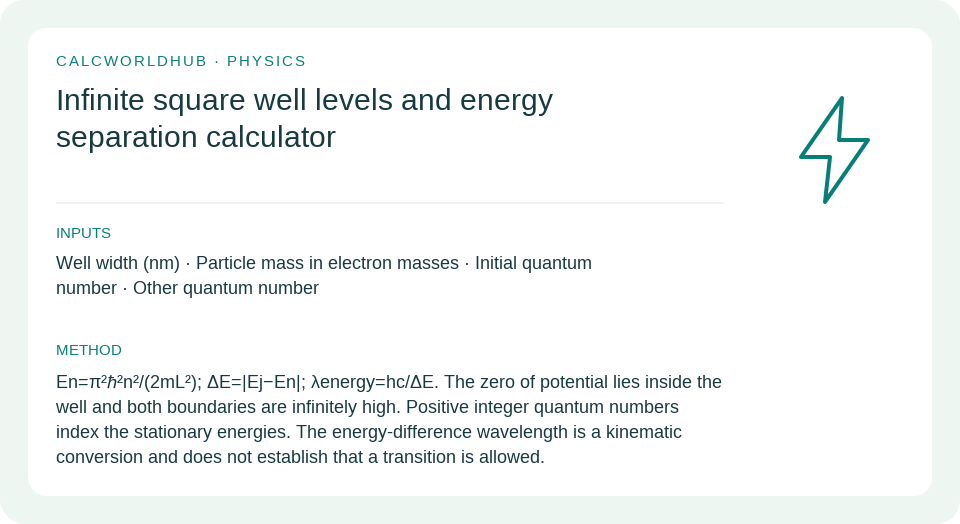
How to use this calculator
Calculate two energy levels of a one-dimensional infinite square well and the photon wavelength corresponding to their energy difference.
- Enter Well width (nm), Particle mass in electron masses, Initial quantum number, Other quantum number. Match the units shown beside each field and review the result together with the assumptions below.
- Read the worked example below to check the expected input format and result.
- Compare another scenario by changing one input at a time. Use Reset to return to the starting values.
Infinite square well levels and energy separation explained
A numerical walkthrough
Well width (nm) = 0.8; Particle mass in electron masses = 1; Initial quantum number = 1; Other quantum number = 3.
- Initial level energy: 0.587547128 eV
- Other level energy: 5.287924155 eV
- Energy separation: 4.700377026 eV
- Energy-equivalent photon wavelength: 263.77500728 nm
The first and third levels in a 0.8-nanometre well differ by a factor of nine in energy. Their separation is eight times the ground-state energy.
The model behind the numbers
En=π²ℏ²n²/(2mL²); ΔE=|Ej−En|; λenergy=hc/ΔE.
The zero of potential lies inside the well and both boundaries are infinitely high. Positive integer quantum numbers index the stationary energies. The energy-difference wavelength is a kinematic conversion and does not establish that a transition is allowed.
What to enter
L— Well width (nm)- Length in nanometres.
m— Particle mass in electron masses- Mass in multiples of electron mass, using the same nonrelativistic particle model at both levels.
n— Initial quantum number- Whole-number count or calendar component in the stated supported range. Enter a whole number.
j— Other quantum number- Whole-number count or calendar component in the stated supported range. Enter a whole number.
Interpreting the result
Nonrelativistic point particle, one dimension, infinite boundaries, and no interactions. Levels exceeding five percent of rest energy are rejected. Finite barriers, band structure, and radiative selection rules are separate.
Reading the outputs
The initial level energy is measured above the well bottom, not above a finite external barrier. Equal quantum numbers give no photon-energy difference.
Frequently asked questions
Can n be zero?
No. The infinite-well boundary conditions start at n=1.
Does every listed energy separation produce a spectral line?
No. Transition matrix elements and selection rules must also permit it.
What changes if the well is finite?
Energy levels and confinement differ, and tunneling can occur.
How do I use the Infinite square well levels and energy separation calculator?
Enter Well width (nm), Particle mass in electron masses, Initial quantum number, Other quantum number. Match the units shown beside each field and review the result together with the assumptions below.
What is a worked example of Infinite square well levels and energy separation?
Well width (nm) = 0.8; Particle mass in electron masses = 1; Initial quantum number = 1; Other quantum number = 3. Initial level energy: 0.587547128 eV Other level energy: 5.287924155 eV Energy separation: 4.700377026 eV Energy-equivalent photon wavelength: 263.77500728 nm The first and third levels in a 0.8-nanometre well differ by a factor of nine in energy. Their separation is eight times the ground-state energy.
Background or definition reference: NIST 2022 CODATA constants.
Read our calculation methodology.