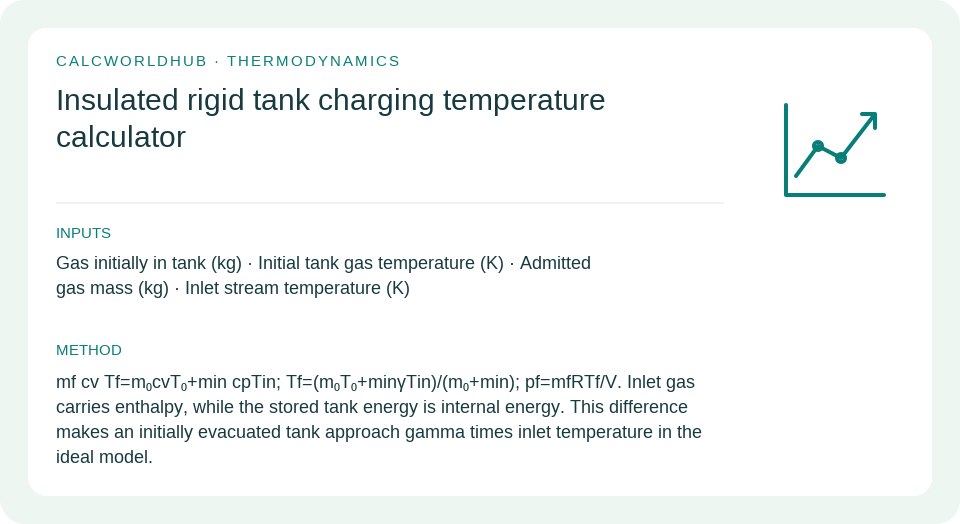
How to use this calculator
Estimate the temperature rise while a prescribed amount of ideal gas fills an insulated rigid receiver.
- Enter Gas initially in tank (kg), Initial tank gas temperature (K), Admitted gas mass (kg), Inlet stream temperature (K), then complete the remaining labeled fields. Match the units shown beside each field and review the result together with the assumptions below.
- Read the worked example below to check the expected input format and result.
- Compare another scenario by changing one input at a time. Use Reset to return to the starting values.
Insulated rigid tank charging temperature explained
Use the initial gas inventory and admitted stream state in the adiabatic energy balance; tank volume sets final pressure but does not affect the ideal mixing temperature.
A numerical walkthrough
Gas initially in tank (kg) = 0.2; Initial tank gas temperature (K) = 300; Admitted gas mass (kg) = 0.8; Inlet stream temperature (K) = 300; Heat capacity ratio = 1.4; Specific gas constant (J/kg/K) = 287; Tank volume (m³) = 0.2.
- Final gas temperature: 396 K
- Final tank pressure: 568260 Pa
- Final gas mass: 1 kg
An insulated 0.2 m³ rigid tank initially holding 0.2 kg at 300 K receives 0.8 kg from a 300 K supply. With gamma 1.4, incoming flow enthalpy raises the final gas to 396 K and 568.26 kPa despite the supply temperature staying 300 K.
The model behind the numbers
mf cv Tf=m₀cvT₀+min cpTin; Tf=(m₀T₀+minγTin)/(m₀+min); pf=mfRTf/V.
Inlet gas carries enthalpy, while the stored tank energy is internal energy. This difference makes an initially evacuated tank approach gamma times inlet temperature in the ideal model.
What to enter
m0— Gas initially in tank (kg)- Initial gas inventory whose internal energy is part of the tank’s starting state; zero is valid for an initially evacuated tank.
T0— Initial tank gas temperature (K)- Starting absolute temperature of the initial gas; it contributes in proportion to the initial mass.
mi— Admitted gas mass (kg)- Mass entering during the fill step; its inlet enthalpy is added to the initial tank energy.
Tin— Inlet stream temperature (K)- Absolute temperature of the entering stream, used to calculate incoming enthalpy.
g— Heat capacity ratio- Ratio γ=cp/cv for the ideal gas; it connects the inlet enthalpy to the tank’s internal-energy balance.
R— Specific gas constant (J/kg/K)- Gas-specific R used with final mass, temperature, and volume to compute absolute final pressure.
V— Tank volume (m³)- Fixed vessel volume used in the final ideal-gas pressure calculation; it does not enter the temperature balance.
Interpreting the result
No outlet, wall heat storage, supply-temperature change or kinetic energy. Final pressure must remain below the actual supply pressure for charging to occur.
Reading the outputs
Final temperature and absolute pressure apply after the admitted gas has mixed uniformly with the initial gas. Final mass is also reported.
Frequently asked questions
Why can filling heat the gas above supply temperature?
Flow work entering with the stream is converted to stored internal energy.
Can the initial tank be empty?
Yes. Set initial gas mass to zero.
Does the model decide when the valve stops flowing?
No. Enter admitted mass and separately ensure the supply pressure can support the calculated final pressure.
How do I use the Insulated rigid tank charging temperature calculator?
Enter Gas initially in tank (kg), Initial tank gas temperature (K), Admitted gas mass (kg), Inlet stream temperature (K), then complete the remaining labeled fields. Match the units shown beside each field and review the result together with the assumptions below.
What is a worked example of Insulated rigid tank charging temperature?
Gas initially in tank (kg) = 0.2; Initial tank gas temperature (K) = 300; Admitted gas mass (kg) = 0.8; Inlet stream temperature (K) = 300; Heat capacity ratio = 1.4; Specific gas constant (J/kg/K) = 287; Tank volume (m³) = 0.2. Final gas temperature: 396 K Final tank pressure: 568260 Pa Final gas mass: 1 kg An insulated 0.2 m³ rigid tank initially holding 0.2 kg at 300 K receives 0.8 kg from a 300 K supply. With gamma 1.4, incoming flow enthalpy raises the final gas to 396 K and 568.26 kPa despite the supply temperature staying 300 K.
Background or definition reference: DOE Fundamentals Handbook: thermodynamic energy balances.
Read our calculation methodology.