How to use this calculator
Compare two plans’ annual premiums and estimated out-of-pocket costs for a user-entered covered-expense scenario.
- Enter Expected covered medical expenses ($), Plan A annual premium ($), Plan A deductible ($), Plan A coinsurance share (%), then complete the remaining labeled fields. Match the units shown beside each field and review the result together with the assumptions below.
- Read the worked example below to check the expected input format and result.
- Compare another scenario by changing one input at a time. Use Reset to return to the starting values.
How this calculation works
A lower premium does not always mean a lower total cost in a year with claims. This scenario calculator adds each plan’s annual premium to estimated member cost sharing for one covered-expense total, then compares the two results.
Inputs and units
expenses— Expected covered medical expenses ($)- Same eligible covered-expense estimate applied to both plans.
premiumA— Plan A annual premium ($)- Annual premium paid for Plan A.
deductibleA— Plan A deductible ($)- Covered expenses paid before Plan A coinsurance begins.
coinsuranceA— Plan A coinsurance share (%)- Member share of eligible costs after the deductible.
oopA— Plan A annual out-of-pocket maximum ($)- Maximum member cost sharing for the modeled covered expenses.
premiumB— Plan B annual premium ($)- Annual premium paid for Plan B.
deductibleB— Plan B deductible ($)- Covered expenses paid before Plan B coinsurance begins.
coinsuranceB— Plan B coinsurance share (%)- Member share of eligible costs after the deductible.
oopB— Plan B annual out-of-pocket maximum ($)- Maximum member cost sharing for the modeled covered expenses.
Formula
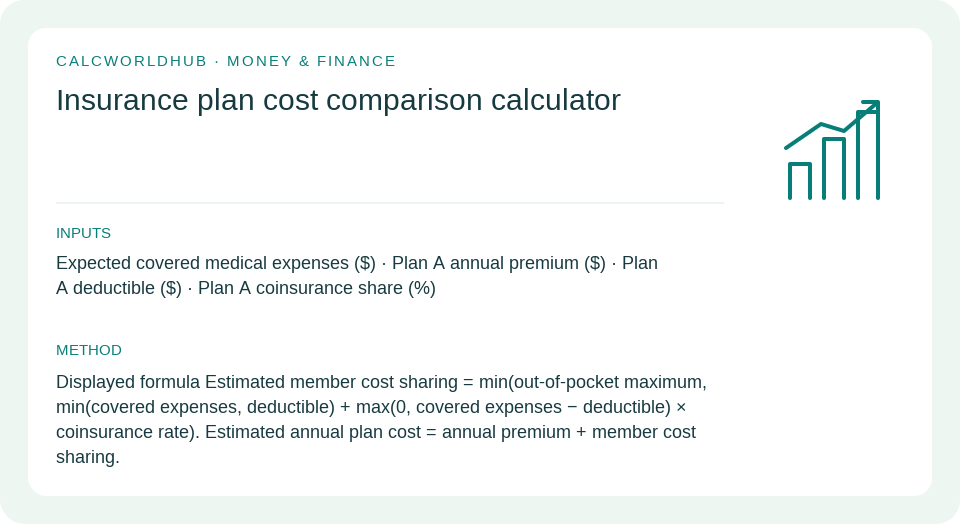
Estimated member cost sharing = min(out-of-pocket maximum, min(covered expenses, deductible) + max(0, covered expenses − deductible) × coinsurance rate). Estimated annual plan cost = annual premium + member cost sharing.
Method
For each plan, enter annual premium, deductible, coinsurance rate, and the applicable annual out-of-pocket maximum. Enter the same expected covered expenses for both plans. The scenario assumes the expenses are eligible and in-network under both policies.
Worked example
For $6,000 of covered expenses, Plan A totals $2,400 premium plus $2,800 member cost sharing = $5,200. Plan B totals $3,600 premium plus $1,500 member cost sharing = $5,100, making Plan B $100 lower in this scenario.
Assumptions and limits
This simplified comparison excludes copays, excluded services, separate drug deductibles, provider networks, employer contributions, tax treatment, timing, and family-level accumulators. Policy rules differ; use the plan documents to confirm which expenses count toward the deductible and out-of-pocket maximum.
Frequently asked questions
Does the plan with the lower result always cost less?
Only for the expense scenario and plan rules entered. Different use or out-of-network care can change the comparison.
Are premiums included in the out-of-pocket maximum?
This calculator treats premium and member cost sharing separately. Confirm how the plan documents define the maximum.
Can I compare family plans?
Only as a simplified total scenario. Family and individual deductibles or limits can have separate accumulators that this page does not model.
How do I use the Insurance plan cost comparison calculator?
Enter Expected covered medical expenses ($), Plan A annual premium ($), Plan A deductible ($), Plan A coinsurance share (%), then complete the remaining labeled fields. Match the units shown beside each field and review the result together with the assumptions below.
What is a worked example of Insurance plan cost comparison?
For $6,000 of covered expenses, Plan A totals $2,400 premium plus $2,800 member cost sharing = $5,200. Plan B totals $3,600 premium plus $1,500 member cost sharing = $5,100, making Plan B $100 lower in this scenario.
Reference: HealthCare.gov glossary for deductibles, coinsurance, and out-of-pocket limits. See our calculation methodology.