Inventory carrying cost calculator
Estimate holding cost for average inventory value over a selected number of days. Enter values to see a free estimate and method.
inputs.
Calculator
How to use this calculator
Estimate inventory holding cost from average stock value, annual carrying rate, and days held. Includes a formula and worked example.
- Enter Average inventory value ($), Annual carrying cost rate (%), Days in estimate. Match the units shown beside each field and review the result together with the assumptions below.
- Compare the worked example with your inputs and result.
- Compare another scenario by changing one input at a time. Use Reset to return to the starting values.
Estimate carrying cost for a defined inventory period
This estimate applies an annual carrying-cost rate to average inventory value for the selected number of days. It is a period holding-cost calculation, not an order-quantity optimizer.
Inputs and units
- Average inventory value ($): Value held over the period, using the same currency as the result.
- Annual carrying cost rate (%): Your annualized holding-cost assumption, entered as a percent.
- Days in estimate: The part-year period to which the annual rate is applied.
Formula and method
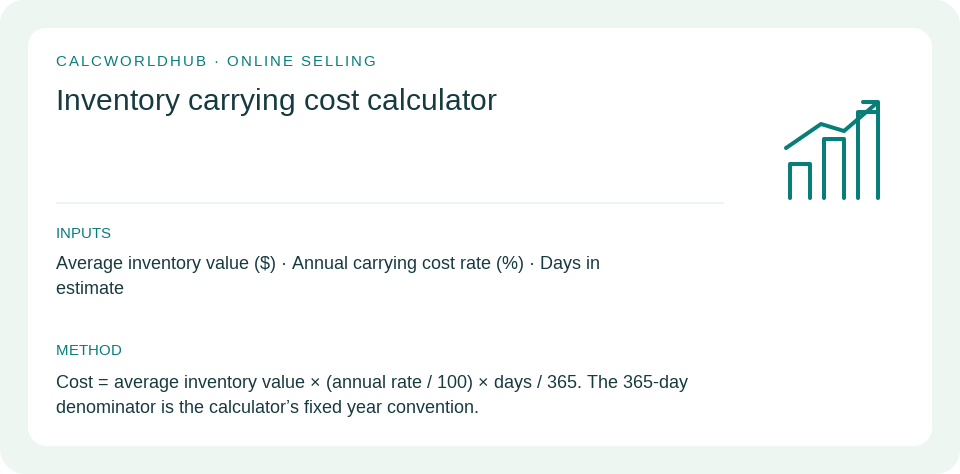
Cost = average inventory value × (annual rate / 100) × days / 365. The 365-day denominator is the calculator’s fixed year convention.
Worked example
For $12,500 at a 24% annual rate over 30 days: $12,500 × 0.24 × 30 / 365 = $246.58 after currency rounding.
Interpreting the result
The result is the holding cost assigned to the entered average balance and period. A higher average balance, rate, or duration increases it proportionally.
Assumptions and limits
The rate is supplied by the user and may combine capital, storage, insurance, shrinkage, or obsolescence. Define those components consistently to avoid double counting. Zero inventory, zero rate, or zero days produce zero cost; a blank field is not treated as a numeric zero.
Frequently asked questions
What can be included in the carrying rate?
Businesses may include capital, storage, insurance, shrinkage, or obsolescence costs. Use a rate that matches your own accounting definition.
Why use average inventory value?
The balance can change during the period; an average is a simple representation of the value held.
Does this include the purchase cost of goods?
No. It estimates a holding cost applied to inventory value, not the original purchase cost.
How do I use the Inventory carrying cost calculator?
Enter Average inventory value ($), Annual carrying cost rate (%), Days in estimate. Match the units shown beside each field and review the result together with the assumptions below.
What is a worked example of Inventory carrying cost?
For $12,500 at a 24% annual rate over 30 days: $12,500 × 0.24 × 30 / 365 = $246.58 after currency rounding.
Read the calculation methodology and privacy policy.
Good calculators show their work.
CalcWorldHub is built around clear inputs and visible assumptions. Results are estimates for planning; check official sources or your provider’s terms when exact figures matter.