How to use this calculator
Update a quasi-Newton inverse Hessian from a measured parameter step and gradient change.
- Enter Current inverse Hessian, Parameter displacement, Gradient change. Match the units shown beside each field and review the result together with the assumptions below.
- Read the worked example below to check the expected input format and result.
- Compare another scenario by changing one input at a time. Use Reset to return to the starting values.
Inverse BFGS curvature update explained
A numerical walkthrough
Current inverse Hessian = [1, 0, 0, 1]; Parameter displacement = [1, 0.2]; Gradient change = [2, 0.3].
- Updated inverse Hessian 11: 0.507494
- Updated inverse Hessian 12: -0.049958
- Secant residual norm: 4.47545209e-16
- Updated inverse Hessian 22: 0.999717
An identity initial inverse Hessian is updated with displacement (1,0.2) and gradient change (2,0.3).
The model behind the numbers
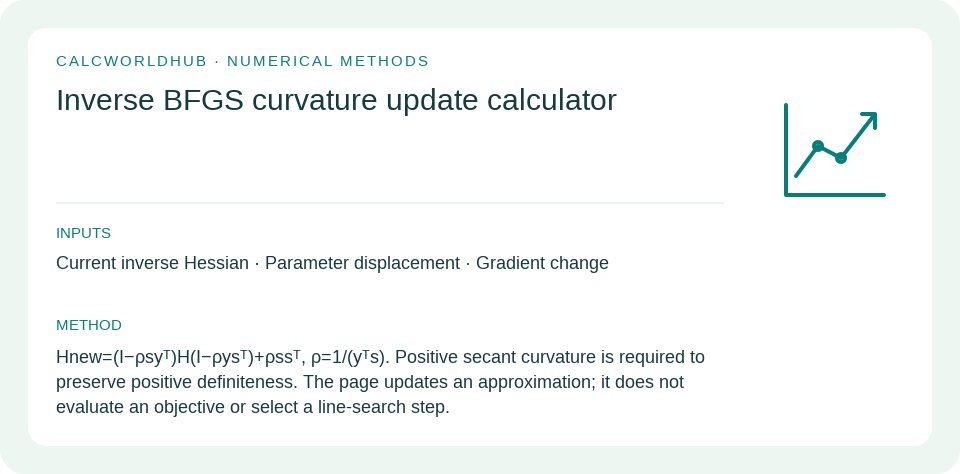
Hnew=(I−ρsyᵀ)H(I−ρysᵀ)+ρssᵀ, ρ=1/(yᵀs).
Positive secant curvature is required to preserve positive definiteness. The page updates an approximation; it does not evaluate an objective or select a line-search step.
What to enter
inverse— Current inverse Hessian- Row-major symmetric positive-definite two-by-two approximation. Use comma-separated values in the stated order.
step— Parameter displacement- New point minus old point. Use comma-separated values in the stated order.
gradientChange— Gradient change- New gradient minus old gradient. Use comma-separated values in the stated order.
Interpreting the result
Two parameters, real symmetric positive-definite input and positive curvature only. Failed curvature should be handled by a safeguarded optimization method.
Reading the outputs
Two independent updated entries and the secant-equation residual are reported; the residual checks Hnew y=s. The 22 component completes the symmetric updated inverse Hessian; the 21 component equals the reported 12 component.
Frequently asked questions
Why reject nonpositive curvature?
The standard update would lose its positive-definiteness guarantee.
Is this the Hessian or its inverse?
Both input and output are inverse-Hessian approximations.
Does satisfying the secant equation make the approximation exact?
No. It constrains only one observed direction.
How do I use the Inverse BFGS curvature update calculator?
Enter Current inverse Hessian, Parameter displacement, Gradient change. Match the units shown beside each field and review the result together with the assumptions below.
What is a worked example of Inverse BFGS curvature update?
Current inverse Hessian = [1, 0, 0, 1]; Parameter displacement = [1, 0.2]; Gradient change = [2, 0.3]. Updated inverse Hessian 11: 0.507494 Updated inverse Hessian 12: -0.049958 Secant residual norm: 4.47545209e-16 Updated inverse Hessian 22: 0.999717 An identity initial inverse Hessian is updated with displacement (1,0.2) and gradient change (2,0.3).
Background or definition reference: Boyd and Vandenberghe Convex Optimization.
Read our calculation methodology.