How to use this calculator
Run simultaneous Jacobi iterations and inspect a sufficient infinity-norm convergence criterion.
- Enter Matrix entries, row-major, Right-hand side, Initial iterate, Iteration count. Match the units shown beside each field and review the result together with the assumptions below.
- Read the worked example below to check the expected input format and result.
- Compare another scenario by changing one input at a time. Use Reset to return to the starting values.
Jacobi iteration and contraction diagnostic explained
Jacobi updates each unknown from the previous iterate; a contraction bound can certify convergence, while a finite iterate alone cannot.
How the calculation works
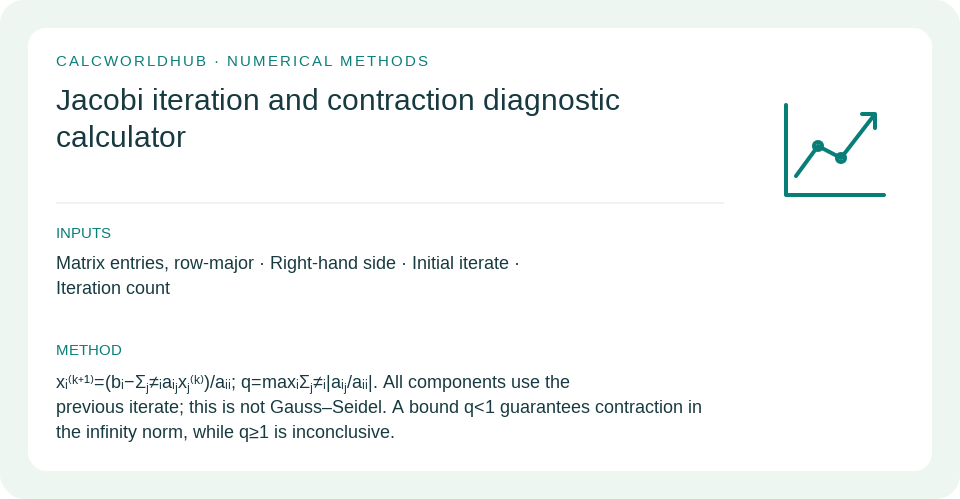
xᵢ⁽ᵏ⁺¹⁾=(bᵢ−Σⱼ≠ᵢaᵢⱼxⱼ⁽ᵏ⁾)/aᵢᵢ; q=maxᵢΣⱼ≠ᵢ|aᵢⱼ/aᵢᵢ|.
All components use the previous iterate; this is not Gauss–Seidel. A bound q<1 guarantees contraction in the infinity norm, while q≥1 is inconclusive.
Set up the calculation
a— Matrix entries, row-major- Square matrix, entered row by row; 2–10 rows are supported. Use comma-separated values in the stated order.
b— Right-hand side- One equation right-hand side per matrix row. Use comma-separated values in the stated order.
x— Initial iterate- Starting unknown vector. Use comma-separated values in the stated order.
steps— Iteration count- Number of simultaneous Jacobi updates. Enter a whole number.
Limits of this model
At most 10 unknowns and 500 iterations. Nondiagonal dominance can converge or diverge; a finite result alone is not a convergence certificate.
Check this example
Matrix entries, row-major = [4, 1, 0, 1, 3, 1, 0, 1, 2]; Right-hand side = [1, 2, 3]; Initial iterate = [0, 0, 0]; Iteration count = 12.
- First solution component: 0.222087
- Infinity residual: 0.00057
- Sufficient contraction bound: 0.666667
- Complete solution vector: 0.222086588542, 0.111083984375, 1.44417317708 component order
Twelve iterations from zero are applied to the symmetric three-equation example; compare the residual with a one-iteration run.
Reading the outputs
The first component is reported with the full-system residual and contraction bound. All components participate in every update. The complete solved vector or profile is also listed in the original component order, so no coordinate is hidden.
Frequently asked questions
Does q above one prove divergence?
No. It only means this sufficient norm bound cannot certify convergence.
Are updates sequential?
No; every new value uses the complete previous iterate.
Why show a residual?
A small iterate change can be misleading; the residual checks the equations themselves.
How do I use the Jacobi iteration and contraction diagnostic calculator?
Enter Matrix entries, row-major, Right-hand side, Initial iterate, Iteration count. Match the units shown beside each field and review the result together with the assumptions below.
What is a worked example of Jacobi iteration and contraction diagnostic?
Matrix entries, row-major = [4, 1, 0, 1, 3, 1, 0, 1, 2]; Right-hand side = [1, 2, 3]; Initial iterate = [0, 0, 0]; Iteration count = 12. First solution component: 0.222087 Infinity residual: 0.00057 Sufficient contraction bound: 0.666667 Complete solution vector: 0.222086588542, 0.111083984375, 1.44417317708 component order Twelve iterations from zero are applied to the symmetric three-equation example; compare the residual with a one-iteration run.
Convergence reference: OSU Ximera, Iterative Methods for Solving Linear Systems; strict diagonal dominance is sufficient, but not necessary, for convergence.
Read our calculation methodology.