How to use this calculator
Correct an observed nucleotide mismatch fraction for multiple substitutions under one of two simple evolutionary models.
- Enter Observed transition fraction, Observed transversion fraction, Correction model. Match the units shown beside each field and review the result together with the assumptions below.
- Read the worked example below to check the expected input format and result.
- Compare another scenario by changing one input at a time. Use Reset to return to the starting values.
Jukes Cantor Kimura corrected DNA distance explained
Correct observed transition and transversion fractions for multiple substitutions under the selected nucleotide model.
How the calculation works
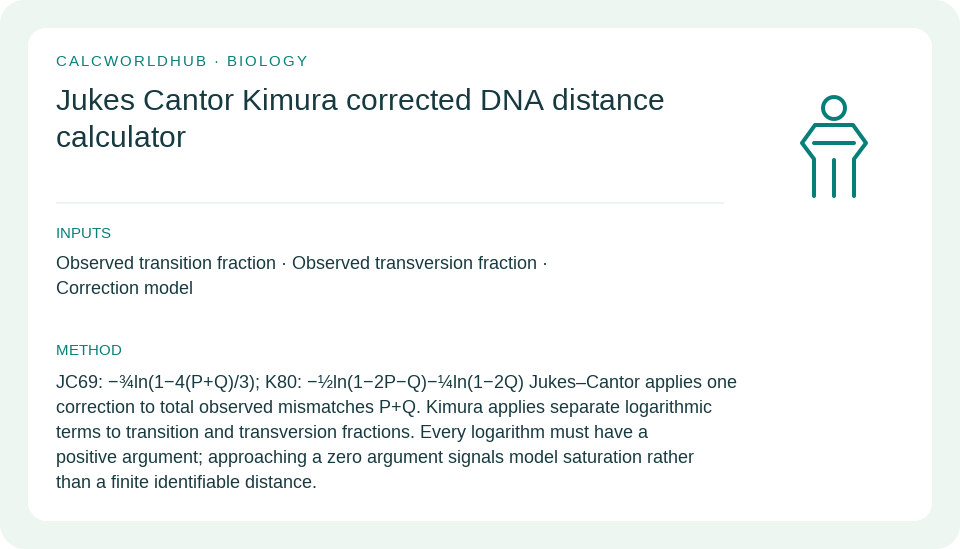
JC69: −¾ln(1−4(P+Q)/3); K80: −½ln(1−2P−Q)−¼ln(1−2Q)
Jukes–Cantor applies one correction to total observed mismatches P+Q. Kimura applies separate logarithmic terms to transition and transversion fractions. Every logarithm must have a positive argument; approaching a zero argument signals model saturation rather than a finite identifiable distance.
Set up the calculation
p— Observed transition fraction- Fraction of aligned sites with a purine-to-purine or pyrimidine-to-pyrimidine difference.
q— Observed transversion fraction- Fraction of aligned sites with a purine-to-pyrimidine or pyrimidine-to-purine difference.
m— Correction model- JC69 assumes equal base frequencies and substitution rates; Kimura’s two-parameter model distinguishes transitions from transversions.
Limits of this model
Aligned homologous sites and model-specific stationary substitution assumptions; saturation boundaries are rejected. Gaps and ambiguous sites must be handled before computing the input fractions.
Check this example
Observed transition fraction = 0.1; Observed transversion fraction = 0.05; Correction model = jukes.
- JC69 corrected distance: 0.16735766 substitutions/site
For P=0.10 and Q=0.05, JC69 gives 0.16736 substitutions/site; Kimura’s two-parameter correction gives 0.17018 substitutions/site for the same fractions.
Interpreting the result
The result is estimated substitutions per aligned site under the selected model, not percent identity. As observed differences approach model saturation, the correction becomes unstable or undefined.
Frequently asked questions
How do the models differ?
Kimura separates transition and transversion fractions; Jukes–Cantor treats substitution types equally.
Does corrected distance equal observed mismatches?
No, it accounts for hidden multiple changes under the model.
What happens at saturation?
The finite logarithmic correction ceases to exist.
How do I use the Jukes Cantor Kimura corrected DNA distance calculator?
Enter Observed transition fraction, Observed transversion fraction, Correction model. Match the units shown beside each field and review the result together with the assumptions below.
What is a worked example of Jukes Cantor Kimura corrected DNA distance?
Observed transition fraction = 0.1; Observed transversion fraction = 0.05; Correction model = jukes. JC69 corrected distance: 0.16735766 substitutions/site For P=0.10 and Q=0.05, JC69 gives 0.16736 substitutions/site; Kimura’s two-parameter correction gives 0.17018 substitutions/site for the same fractions.
External model references: Jukes and Cantor (1969), Evolution of Protein Molecules; Kimura (1980), transition/transversion distance model. These references support the stated correction or definition; calculator assumptions and limits remain as described above.
Read our calculation methodology.