How to use this calculator
Estimate whole kanban cards from daily demand, replenishment lead time, a chosen safety allowance, and container quantity.
- Enter Demand (units/day), Replenishment lead time (days), Safety allowance (%), Container quantity (units). Match the units shown beside each field and review the result together with the assumptions below.
- Read the worked example below to check the expected input format and result.
- Compare another scenario by changing one input at a time. Use Reset to return to the starting values.
Size the card loop from demand during replenishment
A kanban card authorizes a standard container of parts. This estimate covers expected demand during replenishment lead time, adds the safety allowance you choose, then rounds up to a whole number of containers.
Inputs and units
- Demand (units/day): Average consumption per day for the part being replenished.
- Replenishment lead time (days): Elapsed time from the signal until a replacement container is available.
- Safety allowance (%): A planning buffer applied to lead-time demand; it is not a calculated service-level probability.
- Container quantity (units): The fixed number of units authorized by one card; it must be a positive whole quantity.
Formula and method
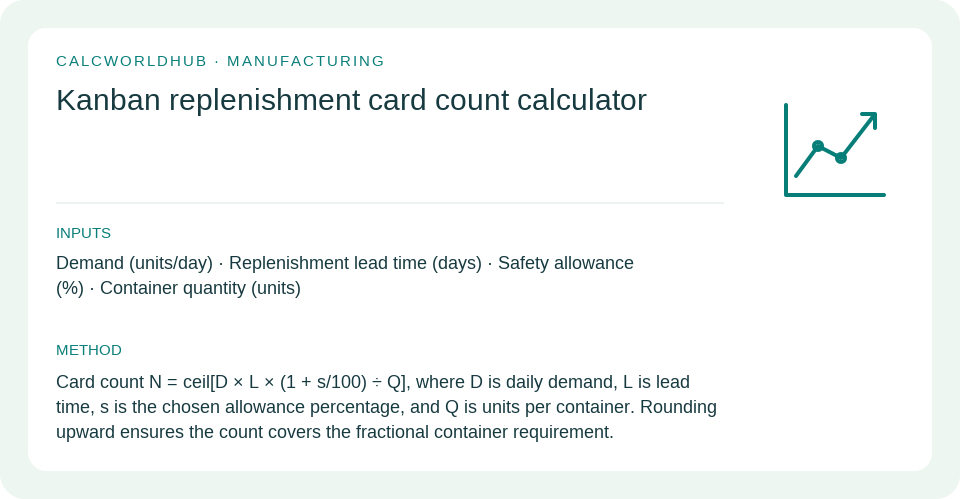
Card count N = ceil[D × L × (1 + s/100) ÷ Q], where D is daily demand, L is lead time, s is the chosen allowance percentage, and Q is units per container. Rounding upward ensures the count covers the fractional container requirement.
Worked example
At 240 units/day and a 0.5-day lead time, expected lead-time demand is 240 × 0.5 = 120 units. A 20% allowance raises coverage to 120 × 1.20 = 144 units. At 20 units per container, 144 ÷ 20 = 7.2, so the loop needs 8 cards.
Interpreting the result
Eight cards authorize 160 units in the loop, including the 144-unit modeled coverage plus the remainder caused by whole-container rounding. Revisit the inputs when demand, lead time, container size, or the chosen buffer changes.
Assumptions and limits
The estimate assumes demand and replenishment lead time are stable over the planning interval. The safety percentage is an explicit policy choice; the result does not promise a particular stockout probability or service level.
Method references
- Oracle JD Edwards: fixed-container kanban equation
- University of Cambridge Institute for Manufacturing: kanban sizing
Frequently asked questions
How do I use the Kanban replenishment card count calculator?
Enter Demand (units/day), Replenishment lead time (days), Safety allowance (%), Container quantity (units). Match the units shown beside each field and review the result together with the assumptions below.
What is a worked example of Kanban replenishment card count?
At 240 units/day and a 0.5-day lead time, expected lead-time demand is 240 × 0.5 = 120 units. A 20% allowance raises coverage to 120 × 1.20 = 144 units. At 20 units per container, 144 ÷ 20 = 7.2, so the loop needs 8 cards.
What does the Kanban replenishment card count calculator calculate?
Estimate whole kanban cards from daily demand, replenishment lead time, a chosen safety allowance, and container quantity.
What assumptions apply to Kanban replenishment card count?
The estimate assumes demand and replenishment lead time are stable over the planning interval. The safety percentage is an explicit policy choice; the result does not promise a particular stockout probability or service level.
Which method does the Kanban replenishment card count calculator use?
Card count N = ceil[D × L × (1 + s/100) ÷ Q], where D is daily demand, L is lead time, s is the chosen allowance percentage, and Q is units per container. Rounding upward ensures the count covers the fractional container requirement.