How to use this calculator
Compare two-crop intercrop yields with sole-crop yields using the land equivalent ratio (LER).
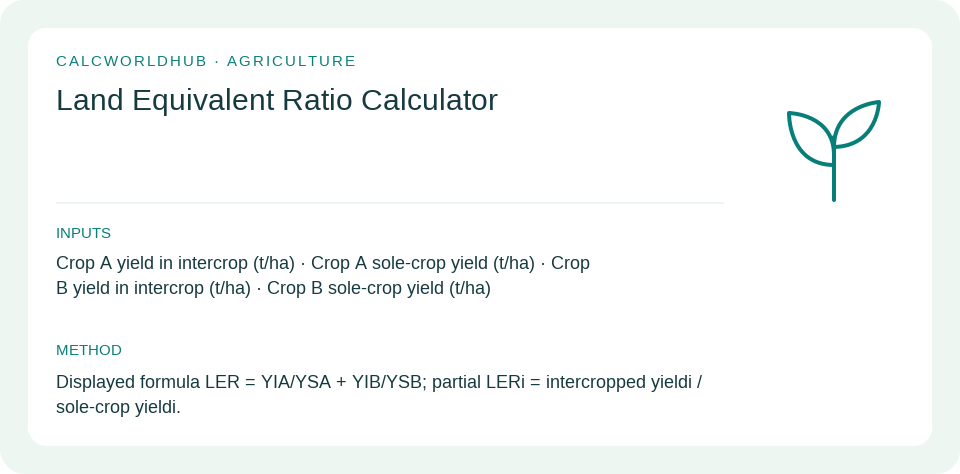
- Enter Crop A yield in intercrop (t/ha), Crop A sole-crop yield (t/ha), Crop B yield in intercrop (t/ha), Crop B sole-crop yield (t/ha). Match the units shown beside each field and review the result together with the assumptions below.
- Read the worked example below to check the expected input format and result.
- Compare another scenario by changing one input at a time. Use Reset to return to the starting values.
How this calculation works
The land equivalent ratio compares the area under sole cropping needed to match the component yields from one unit of intercropped land. This two-crop version reports each partial LER and their sum.
Inputs and units
intercropA— Crop A yield in intercrop (t/ha)- Harvested yield of crop A from the intercropped area.
soleA— Crop A sole-crop yield (t/ha)- Yield of crop A grown alone at the same management level.
intercropB— Crop B yield in intercrop (t/ha)- Harvested yield of crop B from the intercropped area.
soleB— Crop B sole-crop yield (t/ha)- Yield of crop B grown alone at the same management level.
Formula
LER = YIA/YSA + YIB/YSB; partial LERi = intercropped yieldi / sole-crop yieldi.
Method
Enter each crop’s yield in the intercrop and in its sole-crop reference. Both yields for a crop must use the same area, harvest period, and units. The partial ratios are summed.
Worked example
If intercrop yields are 1.2 and 0.8 t/ha, while sole-crop yields are 2.0 and 1.2 t/ha, the partial LERs are 0.600 and 0.667, for a total LER of 1.267.
Assumptions and limits
The comparison assumes the sole and intercrop yields are measured under comparable management and land conditions. LER measures relative land productivity, not profit, crop quality, or environmental impact. Add a partial ratio for every crop in intercrops with more than two species.
Frequently asked questions
What does an LER above 1 mean?
At the same management level, sole crops need more land to match the combined component yields from the intercrop.
Can I mix yield units?
Use matching units for the intercrop and sole-crop yield of each crop. The units can differ between crops because each partial ratio is dimensionless.
Does LER measure profit?
No. It compares land productivity only; it does not include prices, labor, quality, or environmental effects.
How do I use the Land Equivalent Ratio Calculator?
Enter Crop A yield in intercrop (t/ha), Crop A sole-crop yield (t/ha), Crop B yield in intercrop (t/ha), Crop B sole-crop yield (t/ha). Match the units shown beside each field and review the result together with the assumptions below.
What is a worked example of Land Equivalent Ratio?
If intercrop yields are 1.2 and 0.8 t/ha, while sole-crop yields are 2.0 and 1.2 t/ha, the partial LERs are 0.600 and 0.667, for a total LER of 1.267.
Reference: FAO glossary definition and partial-yield formula for land equivalent ratio. See our calculation methodology.