How to use this calculator
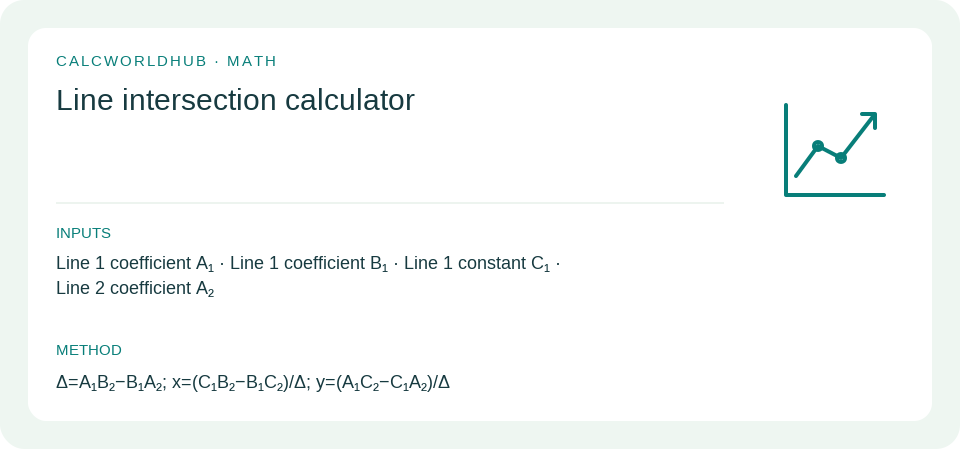
Solve two straight lines written in standard form, A₁x + B₁y = C₁ and A₂x + B₂y = C₂. The result is the unique point satisfying both equations.
- Enter Line 1 coefficient A₁, Line 1 coefficient B₁, Line 1 constant C₁, Line 2 coefficient A₂, then complete the remaining labeled fields. Match the units shown beside each field and review the result together with the assumptions below.
- Read the worked example below to check the expected input format and result.
- Compare another scenario by changing one input at a time. Use Reset to return to the starting values.
How Line intersection calculator works
Solve two straight lines written in standard form, A₁x + B₁y = C₁ and A₂x + B₂y = C₂. The result is the unique point satisfying both equations.
Inputs and units
- Line 1 coefficient A₁: Coefficient of x in line 1; it is not a point coordinate.
- Line 1 coefficient B₁: Coefficient of y in line 1.
- Line 1 constant C₁: Right-hand constant C₁ in the equation A₁x+B₁y=C₁.
- Line 2 coefficient A₂: Coefficient of x in line 2.
- Line 2 coefficient B₂: Coefficient of y in line 2.
- Line 2 constant C₂: Right-hand constant C₂.
Formula and method
Δ=A₁B₂−B₁A₂; x=(C₁B₂−B₁C₂)/Δ; y=(A₁C₂−C₁A₂)/Δ
Worked example
For x+y=5 and x−y=1, adding gives 2x=6, so x=3 and y=2.
Interpreting the result
The ordered pair is the crossing point. Parallel or coincident lines have no unique intersection.
Assumptions and limits
All coefficients and constants must use one coordinate system. Multiplying A, B, and C of one equation by the same nonzero constant preserves that line; near-parallel lines make the intersection sensitive to rounding.
Sources and method
- A line can be represented by an equation from its coordinate coefficients and constants. OpenStax linear functions
Frequently asked questions
Why is there no unique point for parallel lines?
Their direction coefficients make the 2×2 determinant zero, so the equations cannot isolate one coordinate pair.
Can I multiply one equation by a constant?
Yes, multiplying A, B, and C in the same line by the same nonzero constant preserves that line.
How do I use the Line intersection calculator?
Enter Line 1 coefficient A₁, Line 1 coefficient B₁, Line 1 constant C₁, Line 2 coefficient A₂, then complete the remaining labeled fields. Match the units shown beside each field and review the result together with the assumptions below.
What is a worked example of Line intersection?
For x+y=5 and x−y=1, adding gives 2x=6, so x=3 and y=2.
What does the Line intersection calculator calculate?
Solve two straight lines written in standard form, A₁x + B₁y = C₁ and A₂x + B₂y = C₂. The result is the unique point satisfying both equations.