How to use this calculator
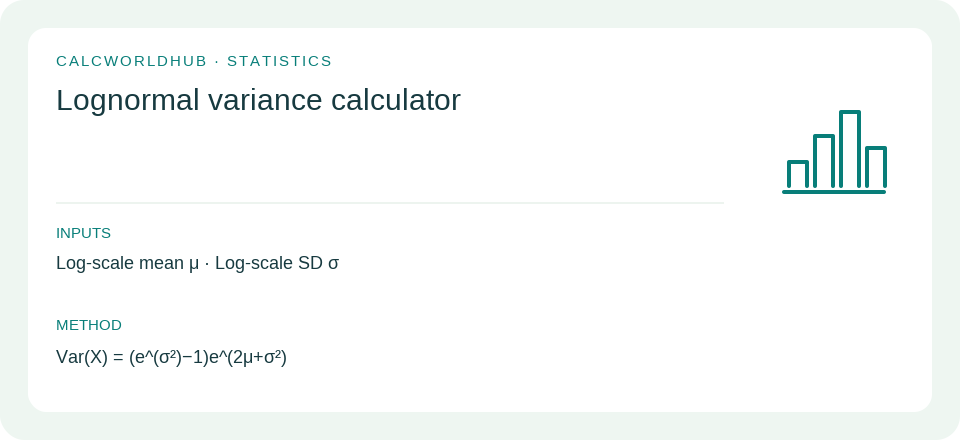
Compute original-scale variance when the natural logarithm has supplied mean μ and standard deviation σ.
- Enter Log-scale mean μ, Log-scale SD σ. Match the units shown beside each field and review the result together with the assumptions below.
- Read the worked example below to check the expected input format and result.
- Compare another scenario by changing one input at a time. Use Reset to return to the starting values.
How Lognormal variance calculator works
Compute original-scale variance when the natural logarithm has supplied mean μ and standard deviation σ.
Inputs and units
- Log-scale mean μ: Mean μ of the natural-log variable; dimensionless when X is expressed relative to its unit.
- Log-scale SD σ: Standard deviation σ of ln(X); nonnegative.
Formula and method
Var(X) = (e^(σ²)−1)e^(2μ+σ²)
Worked example
For μ=0 and σ=1, Var(X)=(e−1)e≈4.671.
Interpreting the result
Variance is in squared original units. It increases with log-scale spread and depends on the chosen scale/unit through μ.
Assumptions and limits
Assumes ln(X) is normally distributed with the supplied natural-log parameters. The mean/variance can grow rapidly; overflow is not a meaningful finite answer.
Sources and method
- If ln(X) is normal with mean μ and standard deviation σ, the variance on the original scale is (exp(σ²)−1)exp(2μ+σ²). NIST lognormal distribution
Frequently asked questions
Is μ the arithmetic mean of X?
No. μ is the mean of ln(X); the arithmetic mean is exp(μ+σ²/2).
Why are units squared?
Variance squares deviations in X’s original measurement units.
How do I use the Lognormal variance calculator?
Enter Log-scale mean μ, Log-scale SD σ. Match the units shown beside each field and review the result together with the assumptions below.
What is a worked example of Lognormal variance?
For μ=0 and σ=1, Var(X)=(e−1)e≈4.671.
What does the Lognormal variance calculator calculate?
Compute original-scale variance when the natural logarithm has supplied mean μ and standard deviation σ.