How to use this calculator
Transform a one-dimensional separation between two events and classify its invariant Minkowski interval.
- Enter Event spatial separation dx (m), Event time separation dt (s), New frame speed divided by c. Match the units shown beside each field and review the result together with the assumptions below.
- Read the worked example below to check the expected input format and result.
- Compare another scenario by changing one input at a time. Use Reset to return to the starting values.
Lorentz event separation and invariant interval explained
How the calculation works
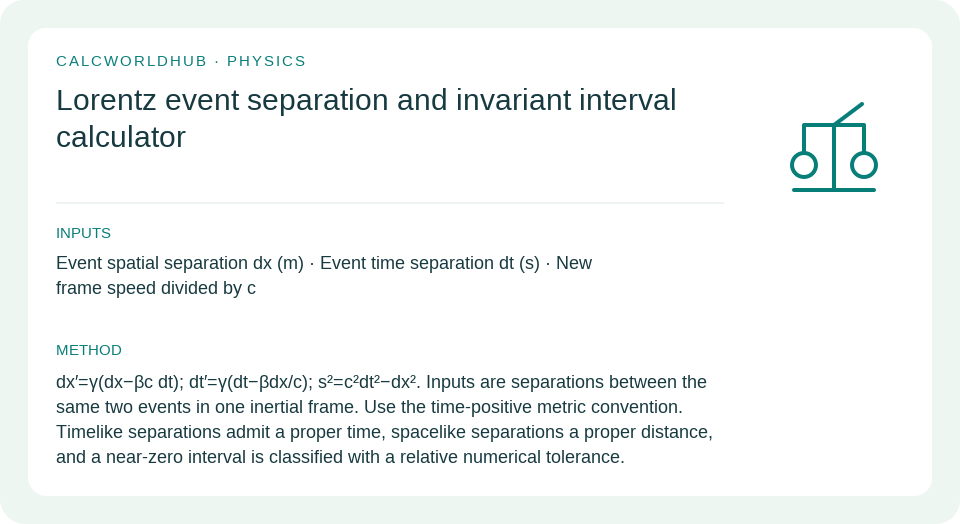
dx′=γ(dx−βc dt); dt′=γ(dt−βdx/c); s²=c²dt²−dx².
Inputs are separations between the same two events in one inertial frame. Use the time-positive metric convention. Timelike separations admit a proper time, spacelike separations a proper distance, and a near-zero interval is classified with a relative numerical tolerance.
Set up the calculation
x— Event spatial separation dx (m)- Signed spatial difference between the same two events in the original frame, in metres.
t— Event time separation dt (s)- Signed time difference between those events, in seconds. It is not an elapsed proper time supplied by a moving clock.
beta— New frame speed divided by c- New frame speed divided by c. This is a dimensionless model parameter unless the label explicitly states a unit.
Limits of this model
Flat spacetime and one spatial boost direction. No general-relativistic curvature or transverse spatial separation. Proper time or distance is labeled inapplicable when its interval type does not support it.
Check this example
Event spatial separation dx (m) = 300; Event time separation dt (s) = 0.000001; New frame speed divided by c = 0.4.
- Minkowski interval c²dt² minus dx²: -124.48212632 m^2
- Moving-frame spatial separation: 196.48667997 m
- Moving-frame time separation: 6.54351533e-07 s
- Interval classification: Spacelike
- Invariant proper time: Not timelike s
- Invariant proper distance: 11.15715583 m
Three hundred metres and one microsecond lie close to the light cone because c times one microsecond is about 299.8 metres. Small input changes can change interval classification there.
Reading the outputs
The transformed time can change sign for spacelike separations without changing the invariant interval. This does not imply a signal travels between those events.
Frequently asked questions
Are these coordinates of a single event?
They are differences between two events, so the origin choice cancels.
Why is proper time missing for a spacelike pair?
No physical inertial clock can traverse a spacelike separation.
Which interval sign convention is used?
Time-positive: c²dt²−dx².
How do I use the Lorentz event separation and invariant interval calculator?
Enter Event spatial separation dx (m), Event time separation dt (s), New frame speed divided by c. Match the units shown beside each field and review the result together with the assumptions below.
What is a worked example of Lorentz event separation and invariant interval?
Event spatial separation dx (m) = 300; Event time separation dt (s) = 0.000001; New frame speed divided by c = 0.4. Minkowski interval c²dt² minus dx²: -124.48212632 m^2 Moving-frame spatial separation: 196.48667997 m Moving-frame time separation: 6.54351533e-07 s Interval classification: Spacelike Invariant proper time: Not timelike s Invariant proper distance: 11.15715583 m Three hundred metres and one microsecond lie close to the light cone because c times one microsecond is about 299.8 metres. Small input changes can change interval classification there.
Background or definition reference: NIST 2022 CODATA constants.
Read our calculation methodology.