How to use this calculator
Compare estimated customer lifetime gross profit with the cost to acquire that customer.
- Enter Estimated customer lifetime gross profit (currency), Customer acquisition cost (currency). Match the units shown beside each field and review the result together with the assumptions below.
- Read the worked example below to check the expected input format and result.
- Compare another scenario by changing one input at a time. Use Reset to return to the starting values.
How this calculation works
The LTV-to-CAC ratio compares a customer lifetime value estimate with customer acquisition cost. The usefulness of the result depends on how lifetime value and acquisition cost are defined and whether they cover the same customer cohort and currency basis.
Inputs and units
ltv— Estimated customer lifetime gross profit (currency)- Use your selected gross-profit lifetime-value estimate, not revenue alone unless that is your chosen convention.
cac— Customer acquisition cost (currency)- Enter the acquisition cost allocated to the comparable customer or cohort.
Formula
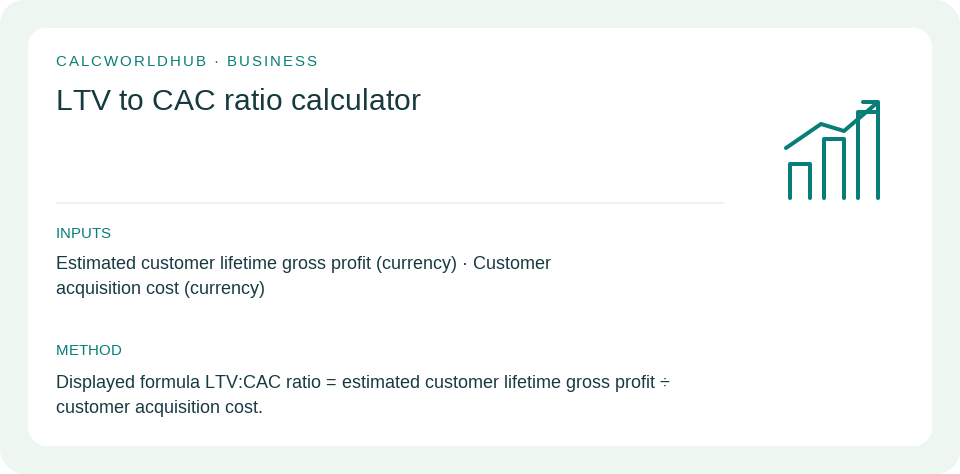
LTV:CAC ratio = estimated customer lifetime gross profit ÷ customer acquisition cost.
Method
Enter an estimated lifetime gross-profit contribution per customer and the acquisition cost allocated to that customer. The output is a multiple, not a profit margin or a guarantee of future retention.
Worked example
An estimated lifetime gross profit of $6,000 divided by a $2,000 acquisition cost gives an LTV:CAC ratio of 3×.
Assumptions and limits
This tool does not estimate lifetime, churn, margin, discounting, or cohort behavior. Both inputs should use compatible time horizons and fully loaded cost definitions for a meaningful comparison.
Frequently asked questions
Should LTV use revenue or gross profit?
Use the definition consistently; this page asks for lifetime gross profit so the acquisition-cost comparison reflects contribution after gross margin under that method.
What costs belong in CAC?
Organizations differ on whether they include sales, marketing, onboarding, and allocated overhead. Use the same cost scope across cohorts.
Does a high ratio guarantee a healthy business?
No. Cash timing, retention assumptions, acquisition capacity, margins, and fixed costs are outside this single ratio.
How do I use the LTV to CAC ratio calculator?
Enter Estimated customer lifetime gross profit (currency), Customer acquisition cost (currency). Match the units shown beside each field and review the result together with the assumptions below.
What is a worked example of LTV to CAC ratio?
An estimated lifetime gross profit of $6,000 divided by a $2,000 acquisition cost gives an LTV:CAC ratio of 3×.
Read our calculation methodology.